
Here at HCS we take on many research challenges and it was a delight to have one that, for once, didn’t involve the murky world of local planning.
Over the bank holiday weekend, we received an email from a gentleman who’d ‘never been to Havant but had a dip in the sea at Southsea during a daytrip about 70 years ago‘. Nigel, a collector of postcards from Chippenham in Wiltshire, had sent us an image showing what was clearly an impressive wedding at St Faith’s, early in the 1900s, and was in search of further information about the ‘happy couple’.

On further prompting, Nigel sent an image of a second postcard, belonging to another collector, which had enabled him to narrow down St Faith’s as being the venue for the wedding. These were clearly two different views of the same event, probably taken by the same photographer.

Step forward our local historians with typical energy and enthusiasm, first on the scene being Ralph Cousins with the news that his memory, or more to the point that of his father, who may even have attended the event, suggested that this was the wedding of “the Reverend Scott’s daughter”.
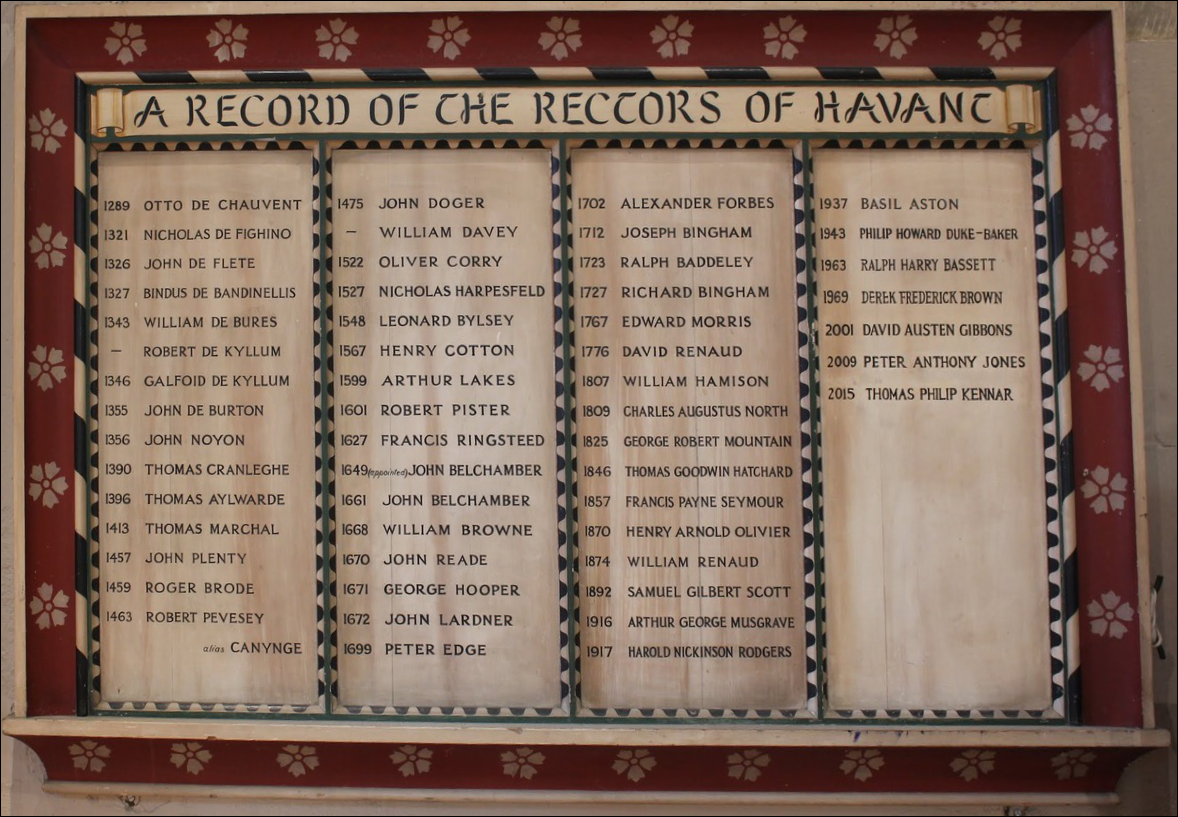
Christopher, our very own HCS planning representative, then offered this image from the church, which narrowed down the likely date:
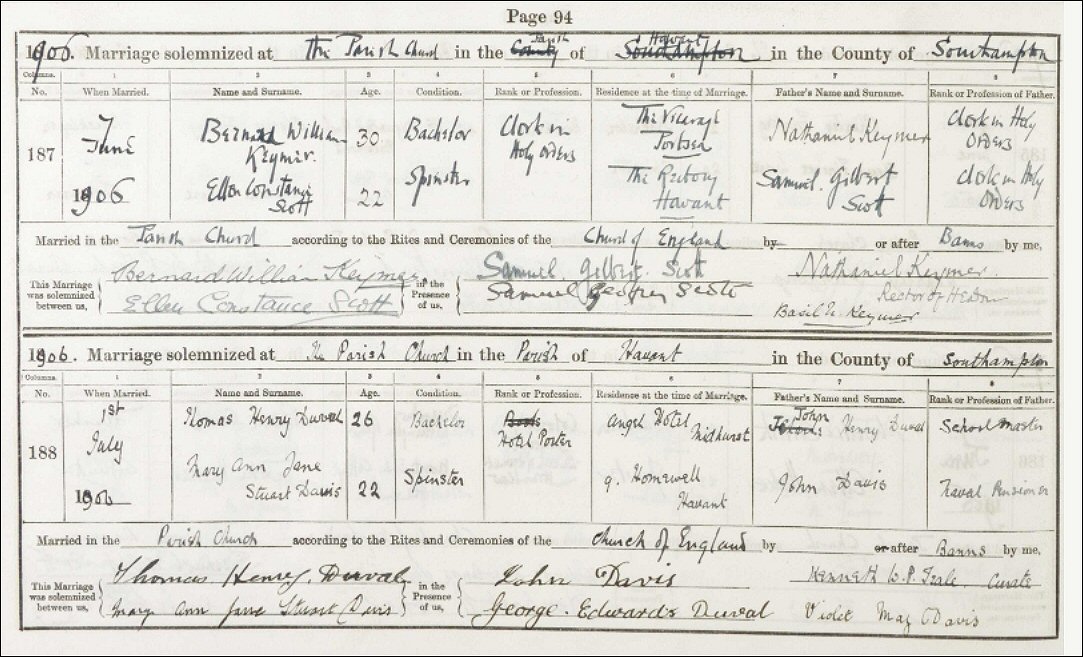
Diving right into the detail as always, Ann Griffiths then completed the picture, coming forward with the register entry from 7 June, 1906.
To provide the icing on “the single tier bride-cake of immense proportions”, Ann then used her expertise and accounts with online resources to come up with images of the contemporary report of the occasion. For ease of reading, the editor has run them through the magic of Google ‘Keep’ to provide this readable copy:
Local Weddings
Keymer – Scott
Considerable interest was manifested yesterday in the wedding of Miss Ellen Constance Scott, third daughter of the Rev. Canon S. G. Scott, Rector and Rural Dean of Havant and of Mrs. Scott; The Rectory, Havant, to the Rev. Bernard William Keymer, M.A., Senior Curate of St. Mary’s Church, Portsea, son of the Rev. Canon Keymer, Canon of Southwell, and Rector of Headon, Notts.
A large and fashionable congregation attended at the Parish Church to witness the ceremony. The officiating clergy were the Rev. Gahon Reymer (father of the bridegroom) the Rev. Bernard Wilson (Vicar of Portsea), and the Rev. A. Mayhew, M.A. Mr. Hugh Burry, the organist of the Portsea Parish Church, played suitable selections while the guests were assembling. The service was fully choral, and the local choir was augmented for the occasion by several choristers from St. Mary’s, Portsea. During the service the hymns “Holy, Holy, Holy, Lord God Almighty”, “May the grace of Christ our Saviour”, “Lead us, Heavenly Father, Lead us”, “Now thank we all our God,” and “O Perfect Love,” was sung.
The bride, who was given away by her father, wore a very lovely gown of rich white Duchesse satin trimmed with beautiful rare old Limerick lace; and a tulle veil was arranged over a coronet of orange blossoms. She carried a sheaf of white lilies tied with white satin ribbon, the bestowal of the bridegroom. There were four bridesmaids – Miss L. Mabel Scott and Miss Bertha M. Scott (sisters of the bride). Miss Dorothy Sprigg and Miss Muriel Soames (cousins of the bride). They were wearing picturesque gowns in flowered mousseline-de-soie, the white ground showed a design of small sprays of sunrise roses, and contrasted with deep swathed ceintures in apple green taffetas, their picture hats were of white crinoline, with white chiffon scarfs and green foliage, and wore gold brooches set with a pearl and turquoise bee, and carried shower bouquets of sunrise roses, the gifts of the bridegroom. The Rev. H. Courtenay Wilson was best man.
Mrs. Scott (mother of the bride) was very handsomely gowned in brown voile, and smart vieux rose toque, and carried a bouquet to correspond. A pretty compliment was paid to the bride by twenty candidates of the Havant Branch of the G.F.S., who lined the centre aisle of the church, and were quaintly dressed in white muslin frocks, mob caps of the same material, white mittens, and green sashes to match the shade introduced in the bridesmaids’ gowns. Each carried a fancy basket filled with blooms, which they strewed in the pathway of the bride and bridegroom as they left the church.
The reception was held in the Rectory grounds, the guests being received by the bride’s parents under some fine old cedar trees. The buffet table on the lawn was magnificently garnished with the choicest of pale pink roses. Elevated on a high and massive silver stand, was the single tier bride-cake of immense proportions. Which was beautifully decorated with a bold border of sugar roses, with their foliage, intermingled with marguerites; the surface of the cake was ornamented with an exquisite lace pattern. The base was moulded in shell and trellis designs piped in high relief, and finished with silver ornamentation. The whole surmounted with an elegant silver trumpet-shaped vase, holding a natural bouquet of lilies of the valley, from which were suspended trails of smilax. Over the table was a canopy formed with festoons of smilax, at intervals on the table in polished silver holders were choice bouquets of the pink roses, mounted with asparagus fern.
The dessert added yet another attraction to this beautiful floral display. The cake and catering were entrusted to Mr. W. S. Brewer, 34, Clarendon Road, Southsea. After the reception the Rev. B. W. and Mrs. Keymer left for London, en route for Scotland, for their honeymoon, the bride going away in a toilette of light voile, with black leghorne hat trimmed with blue ribbon and pink roses.
In honour of the happy event a wedding peal was rung at the St. Mary’s Church, Portsea.
As Canon Tom Kennar, the incumbent rector of the historic church that provides the Society’s logo remarked,
“Well done everyone! What a team!”
 Havant Civic Society