
This is a fairly weighty post. To download a four page printable copy of the text, click here.
To recap
In December 2023, Havant Borough Council signed a five-year contract worth up to £245,000 with Arcus Global to replace its ageing idox/Acolaid planning system with a cloud-based alternative. The new system, Arcus Built Environment – developed on the Salesforce platform – is a relatively recent entrant among providers of planning and built environment software solutions.
The Arcus Built Environment implementation for HBC was launched following a scheduled system shutdown in August 2025, revealing a bare-bones implementation with minimal local configuration – a decision seemingly driven by short-term cost-saving priorities. Most concerning, however, is the unexplained decision not to migrate the legacy planning archive into the new system, leaving a critical gap in continuity and public record access.
The consequences have been immediate and significant. Residents and professionals alike reported the council’s failure to process Local Land Charges searches, resulting in delays to property transactions and the unavailability of historical planning records. These failings have generated widespread frustration and prompted serious concerns about the system’s implementation and the accountability of those responsible. The council has offered little transparency, leaving external stakeholders to rely on the use of Freedom of Information requests and formal complaints to attempt to gain information and reconstruct what went wrong.
Soon after residents first reported the council’s inability to perform its statutory duty of processing Local Land Charge searches, Havant Civic Society alerted the Planning Services team to much broader system issues with the borough’s new planning system implementation. At the same time, we stressed the critical importance of taking swift corrective action. In the absence of any response from the HBC management team, we published our first report on the growing chaos on 2 October 2025.
HCS oversight of local planning
Since its relaunch in 2017, the Havant Civic Society website has consistently informed residents about the council’s problematic planning applications. Through regular deputations to the Planning Committee, the Society has sought to challenge unsound Officer recommendations before they become formalised in decisions which result in lasting harm to the borough.
Despite submitting rigorously evidenced representations, the Society’s efforts have achieved limited traction over that period. The flawed procurement and short-sighted implementation of the Arcus planning system offer a plausible explanation. This current breakdown in due process is symptomatic of a broader institutional resistance to evidence-based scrutiny, underpinned by opaque decision-making and a persistent disregard for established governance protocols.
Notable examples of unsound planning decisions include the Portsmouth Water ‘New HQ’ planning application in June 2025, an application which had remained stalled since 2021 due to the sheer volume of valid public objections. Equally concerning was the decision to approve the application for development of an Amazon delivery station in New Lane, submitted under a cloak of anonymity and fast-tracked to final approval in 2023 under external political pressure.
Crucially, the essential operational management controls set as conditions on its original approval were stripped out by a rushed and deeply flawed Section 73 amendment following commercial pressure from the intended occupant.
Common threads in these applications include discontinuity of leadership, disproportionate influence exerted by landowners and commercial developers, external political pressure and a recurring pattern of circular accountability between Havant Borough Council’s Planning Services and Hampshire County Council’s highway authority.
Why is the Planning Data Archive important?
The detailed history of planning data is essential for the processing of Local Land Charge searches, and the loss of the Council’s ability to perform this statutory duty was the first visible indication of a problem. However, there is a much broader consequence of the failure to restore the planning archive. The content and historical sequence of planning application files and public comments provide the essential evidence base for understanding how decisions were made on major projects.
Planning application records are typically retained for 15 years after closure, especially where they relate to built development or enforcement. This is considered best practice to support legal defensibility, historical reference and ongoing operational use. Some councils retain planning data for even longer, particularly where digital systems allow it without undue cost of storage.
In a nod to the ongoing Local Government Reorganisation, the Town and Country Planning (Development Management Procedure) (England) Order 2015, as currently amended, legislates that the statutory duty to retain and make available planning application documents transfers to any successor authority if a local planning authority ceases to exist or its functions are reassigned.
It is reasonable to assume that HBC Planning Services officers and management played a significant role in shaping the business case and influencing the procurement decision to select the Arcus solution. Given that involvement, it should have been self-evident that full conversion and migration of the planning data was a non-negotiable requirement for any new system implementation.
Enablement of Mapping Functionality
Before the Arcus rollout, Havant’s planning and land charges data was supported by two systems: Tyler Technologies for land charges mapping and Astun Technology’s iShare platform for public planning application mapping. These platforms allowed residents to view planning applications on interactive maps – seeing exactly where proposals were located and how they affected surrounding areas.
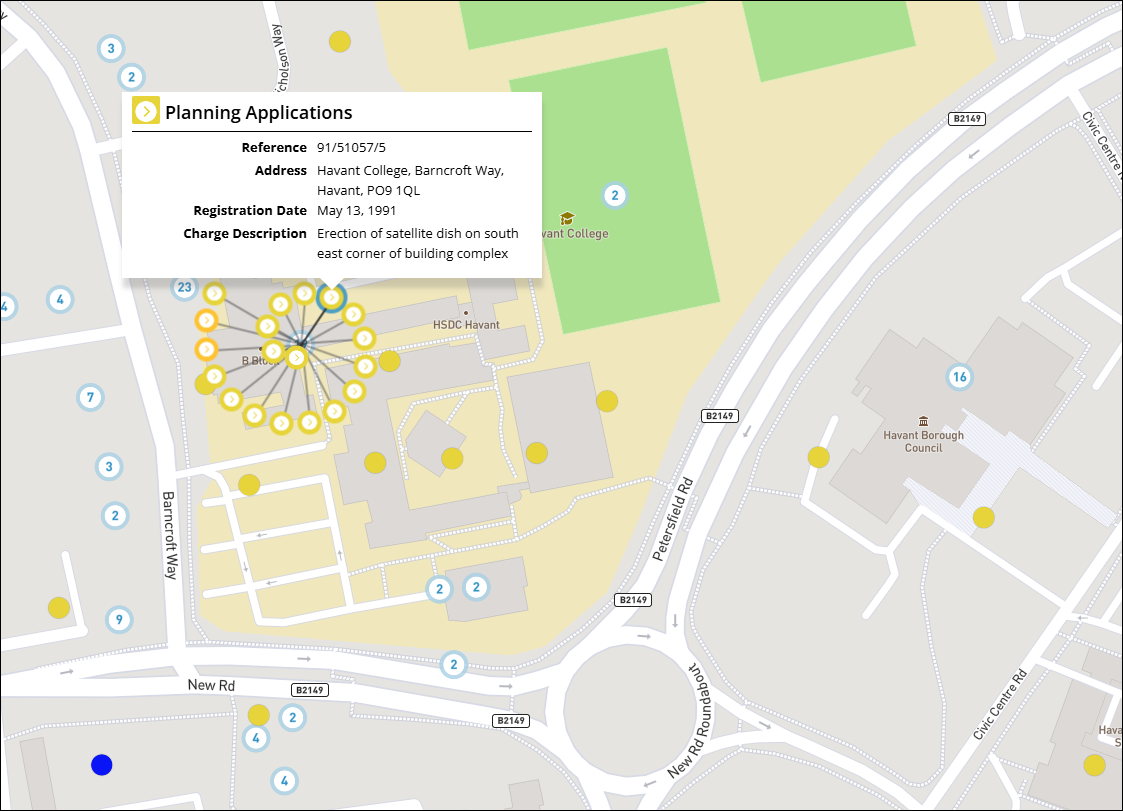
Arcus Built Environment, even in its out-of-the-box- state, includes built-in mapping features through its partnership with GIS provider CadCorp. But so far, there’s no sign of a working public mapping interface in the HBC implementation. It appears that the mapping function has been disabled or is not yet operational, the most likely reason being that the older planning data hasn’t yet been fully migrated. While the legacy systems may remain online, they’ve been disconnected from live data and have not been updated since July. Where links to a planning system are included, they refer to the previous solution and consequently fail.
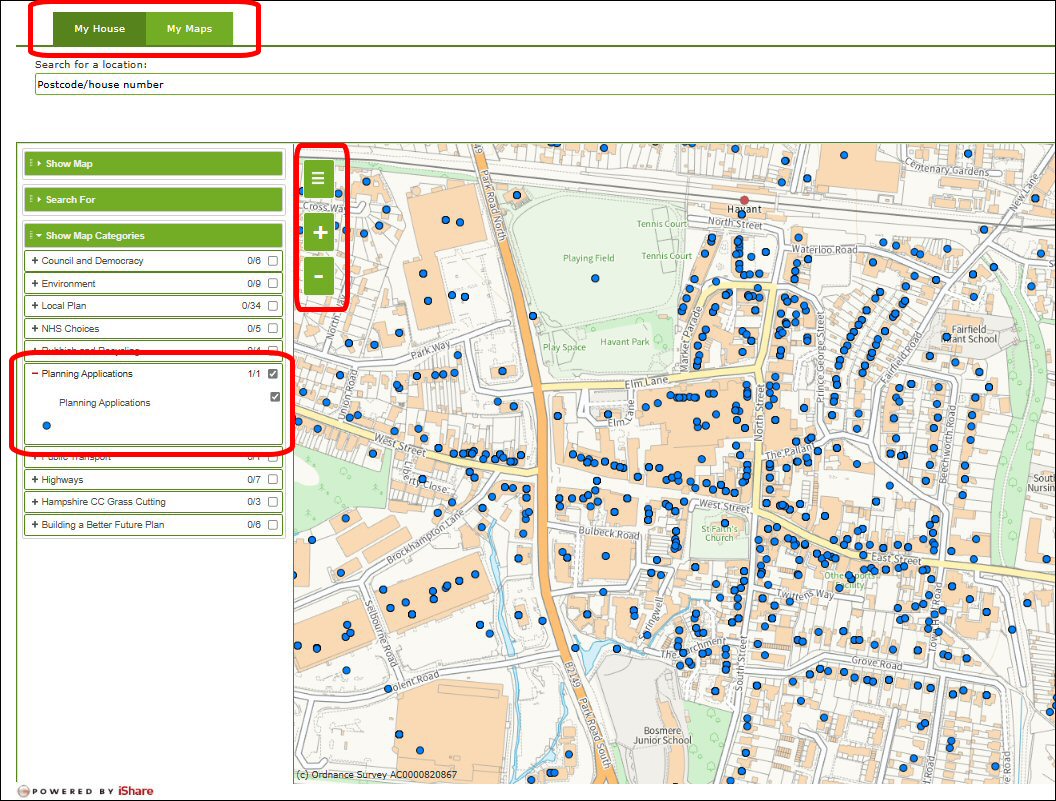
To restore a working, publicly-accessible mapping function that shows both current and historical planning applications, all spatial data from the old systems would need to be carefully merged and migrated into Arcus/Cadcorp, a non-trivial task. Each system stores data differently, so the information would need to be extracted, cleaned, and reshaped to fit together properly. That includes converting map layers, matching property references, and ensuring boundaries are accurate.
Restoration of the Archive
There was only one comprehensive and auditable approach to conversion and migration of the planning data, and that would have been by using a system conversion step as a predecessor to the implementation of the new system. Arcus Global claims to have a wide variety of conversion procedures to handle application file and spatial data from a variety of sources, including those previously used by HBC.
However, despite the existence of those conversion routines, there would likely be an additional requirement for bespoke logic to address the need to merge spatial data from the two separate mapping system sources with the planning application data from the idox/Acolaid planning system. Conversion would have been relatively complex and certainly not cheap. It was nevertheless an essential requirement and should have formed part of the full business
case for Arcus Global. There would also have been a need for effort by council staff to test multiple test iterations of the migration, validate the results, and confirm its readiness for live use.
The way forward
The council has a critical decision to make. The unwise decision would be to continue with the current ad hoc approach seemingly being adopted by HBC officers: manually restoring individual planning cases, presumably from fragmented offline records, as and when prompted by incoming Local Land Charge search requests, FOI enquiries, or Planning Committee schedules. This is a reactive method which smacks of panic; it is inconsistent, vulnerable to file linkage errors, and open to manipulation through selective omission of inconvenient records. Most critically, it is un-auditable and resource-intensive – a process wholly unsuited to the demands of transparent, accountable governance.
In response to a Freedom of Information request (24-536) for an account of HBC Planning Services officers’ time, the Information Governance officer stated “Unfortunately, the information you have requested is not held by Havant Borough Council. Members of staff in the Planning Service do not use a time recording system and so we are unable to provide the information requested.” It is therefore highly probable that the cost of restoring planning data on a case-by-case basis is both substantial and undocumented. Visible errors and inconsistencies arising from this fragmented process are already evident in the system’s data, undermining confidence in its integrity and operational reliability.
However unpalatable it may appear, the correct and necessary course of action is as follows:
The Council’s management team must now act decisively: suspend the system and initiate a full, independently audited migration of planning data from verified sources. This is essential to establish a clean base and ensure the integrity of the Arcus planning archive. Any further delay will compound wasted effort, as unaudited manual corrections will ultimately be overwritten by a properly controlled migration.
During this process, the Council must impose a moratorium on validating new planning applications – thereby pausing associated consultations – and halt decision-making on any current cases where unaudited manual data restoration may have taken place.
Failure to act decisively risks breaching statutory duties and exposing the authority to legal challenge and regulatory intervention.
Responsible and Accountability
HCS has not yet seen the detail of the Full Business Case that led to the new system, but experienced planning officers should have been instrumental in shaping the specification. What we do know is that the final procurement decision was signed off by the Head of Place in December 2023, twelve months before he resigned from the borough.
Capita was contracted to manage the procurement process on behalf of the council. Given their recent involvement in the Langstone flood defence scheme – which was delayed by a year due to incorrect tender specification – it’s reasonable to ask whether Capita also bears some responsibility for the planning system’s shortcomings.
Then there’s Arcus Global, the company that supplied the new system under the UK Government’s G-Cloud framework. Did they warn HBC about the risks of using their product without proper archive data migration? Or did they simply allow an ‘out-of-the-box’ setup to go ahead, knowing it wouldn’t meet the council’s needs?
It’s also worth asking whether Capita and Arcus are shielded by the G-Cloud framework, run by Crown Commercial Services, which allows public bodies to buy digital services without running a full competitive tender. If so, does this process offer enough protection for councils – or enough accountability when things go wrong?
In Summary
Havant Borough Council’s deployment of the Arcus system appears to reflect a cost-prioritised strategy compromised by insufficient internal IT capacity – an outcome of sustained outsourcing – and further weakened by a lack of leadership continuity, raising concerns about strategic oversight and operational resilience.
The decision to adopt a basic off-the-shelf implementation and forego full data migration has led to serious disruptions and raised concerns about transparency and governance. The current manual, reactive case-by-case restoration of case details lacks auditability, is prone to error, and risks perceptions of inconsistency.
While Havant’s experience is not unique – mirroring national trends of planning bias and digital transition challenges – it demands urgent scrutiny. Residents and local businesses deserve a planning system that works, a mapping interface that informs, and a council that is accountable for its decisions.
 Havant Civic Society
Fabulous and detailed explanation.
No time recording by underpaid council planning staff! My feeling is that the committed staff work long hours for inadequate reward.
Capita will have been selected via tender. Capita has a mixed reputation I believe at best.
I would love to know if Chichester District Council is in any way impacted by having chosen the same supplier.
Thank you very much HCS.
LikeLiked by 1 person
This is a cloud based solution. Did that go down when AWS had its outage recently? Using a single cloud is always a risk that most companies do not appreciate. ________________________________
LikeLike
could this also be caused by a lack of continuity in communication between staff working from home etc. on different days just a point that may need to be Considered or perhaps not. Regards Richard Easton
LikeLike
Hi
Why did HBC and others have to move away from the previous planning system? HBC still use other systems from this supplier.
LikeLike