
Havant Borough Council remains silent on its glaring failure to migrate over fifteen years of planning data, while administrative staff – apparently assisted by Arcus Global – compound the problem through ad‑hoc, unmanaged and inconsistent manual update activity. Over the last couple of months, HCS has tracked a steady stream of issues. The evidence from this record makes it plain that the Arcus planning system remains in flux, with ongoing changes driven by problems surfacing during live deployment.
In addition to changes to the user interface, the underlying database of ‘decided’ application case data, which should have been fully migrated from the previous idox/Acolaid base as an integral part of the implementation project, continues to be manually updated on an ad hoc basis, presumably through back-office functions of the still-unstable system.
Ensuring easy public access to planning data is vital: it underpins local land searches in property conveyancing, provides clarity on the evolution of development, and verifies that new projects comply with the detailed conditions of site approvals. Since development often doesn’t start until almost three years after a planning application (case) is decided, online access to the complete portfolio of ‘decided cases’ should have been a critical requirement for migration to the new system and database.
We’ve posted the latest update to our Arcus System Issues log, but given the constantly changing system function and data content, that log now simply demonstrates that the Arcos implementation is still being tested and is no closer to being production-ready.
Ongoing examples of planning data corruption
Using images valid at the date of publication, this article presents a small sample from the planning applications on the live public register, looking first at their ‘Comments‘ tab, then at their ‘Files‘. These are by no means isolated examples, but are typical of the planning details currently being displayed in the Arcus planning register.
Examples of data corruption – ‘Comments’
The first thing to notice in the examples below is that for applications ‘decided’ before September 2025, the date against each comment is the same – 6 August 2025. That is most likely to be the date on which a bulk data extract/load system activity processed and has nothing to do with the history of the case data.
Example 1
In this example, you can see two more common data corruption issues – not only are some comments duplicated, but in many instances, they are actually truncated with no option to view the complete comment.
We cannot tell whether the comments have simply been truncated in the screen display, or have been truncated on the database through a failed data extract/load. Either way, the observed system function is not fit for purpose.

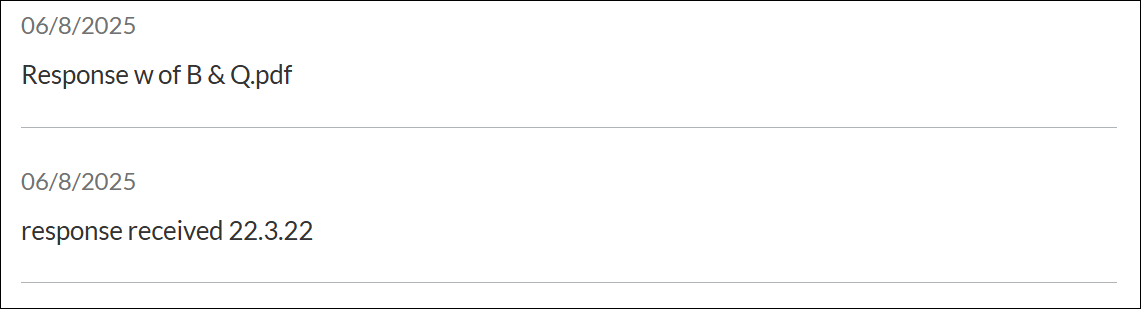
Example 2
Here the first comment appears to show a data file name, but with no link to its content there is no way of understanding what it means or indeed, whether or not such a file actually exists in the database.
The second comment implies that a comment was received on 22 March 2022, despite its displayed date of 6 August 2025, with no way of finding out whether the detail of the response actually exists in the case files.
Example 3
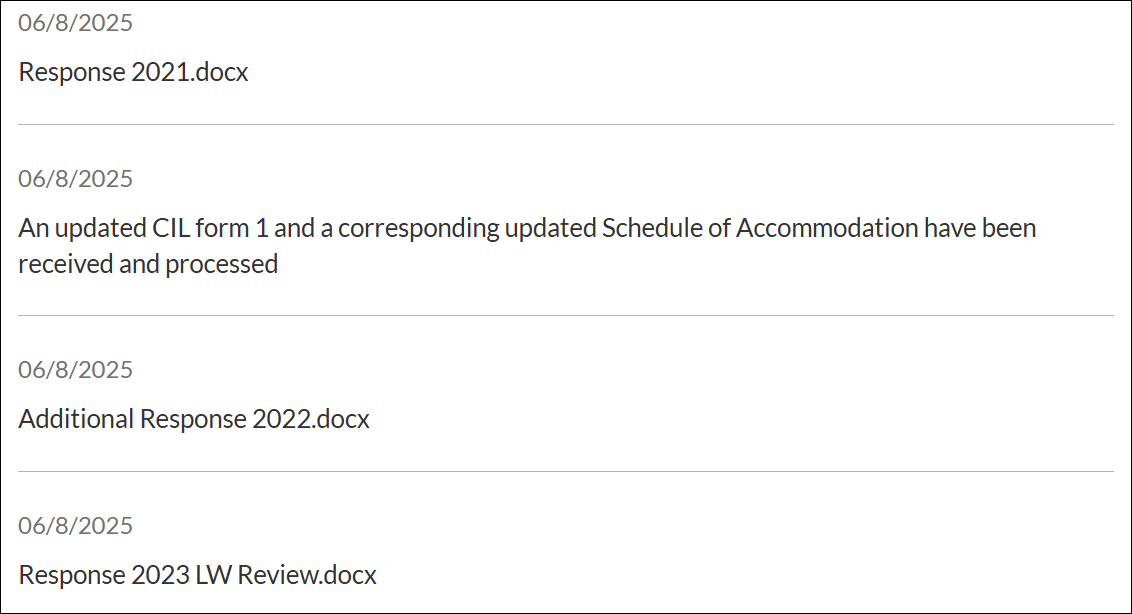
Example 3 , taken from another ‘decided’ planning application, depicts four comments in a group. Three of them refer to Microsoft Word documents with dates of 2021, 2022 and 2023 respectively in their file names. Once again, without any link to the documents, we cannot tell if they even exist.
The other comment tells us that an ‘updated CIL form 1’ and an ‘updated Schedule of Accommodation’ were received and ‘processed’. But what should the date be and where can we find them?
Example 4
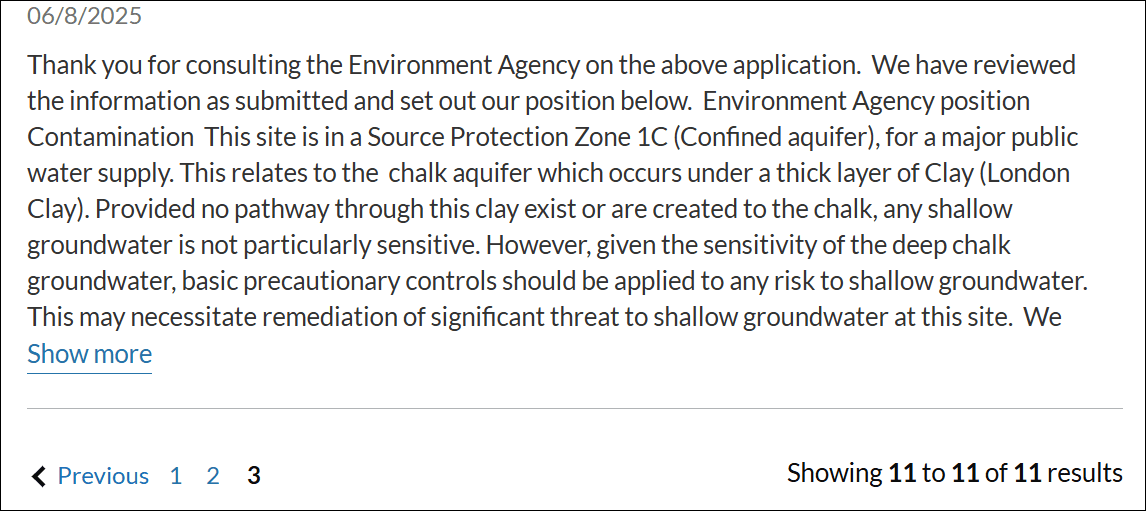
The comment shown in this next example is clearly a Statutory Consultee response from an Environment Agency representative which, under the previous planning system, would have been filed as a ‘Document’ rather than a (public) ‘Comment’. Here we have a ‘Show more’ link enabling the full text of the document to be read. The date, of course, is set to 6 August 2025, despite the fact that this response could date back as far as 2021.
The total number of comments on this particular planning application, is shown as just eleven. However, since this example refers to one of the more contentious planning decisions of recent years, we are certain that there were in excess of three hundred comments recorded against this application before the recent planning system upgrade.
Examples of data corruption – ‘Files’
The previous example demonstrated the apparent loss of several hundred comments from a particular decided case, so now we look at the ‘Files’ recorded for the same case.
Example 5
The total number of documents is shown as 29, which is a marked improvement over the total of 0 (zero) which we first reported to Planning Services in September 2025. However, the fact remains that for this planning application, the previous planning system contained a great many more. In summary, the example below demonstrates the ‘disappearance’ of several hundred documents from the case.

Comparing the ‘Filter‘ sections of the example shown above and the one in the next example, demonstrates another issue regularly seen.
Example 6
The list of categories offered to the user appears to be built dynamically in the Arcus system based on the category values applied to the documents pertinent to the case. This piece of ‘geek speak’ simply means that the list of values selectable under Category will not always be the same in the next application you look at.
These category values should have been set or defaulted automatically by the process for migration of data from the old system to the new. That clearly did not happen so what you see here for ‘decided cases’ is whatever the planning services and Arcus teams have been manually updating since the system was declared live, apparently with no consistent standards applied.
For new applications, we would hope that a better level of accuracy would be achieved. In the example shown below there are 19 documents. A category value of ‘None’ has no meaning; if a document does not fit an available category, it should be recorded as ‘Miscellaneous’ or some other such default value.
Similarly, a Status of ‘None’ has no meaning. The case data element ‘Status’ should always have a value, even if a default value of ‘Not set’ is considered valid for reporting purposes. The ability to distinguish between Submitted and Amended versions of documents is important. In some ‘decided’ cases, the relationship between correctly dated comments and the amendment history of documents can be of critical importance to the integrity of the decision.

Example 7
The system specification presented in the formal requirements to suppliers in 2023, under Section E – Public Access, lists ‘E.9 – Easy for the public to view, filter, sort documents‘ as a ‘Mandatory‘ requirement.
The current Arcus Planning system, as implemented for Havant BC, forces downloads of documents for viewing on a local device, an approach which does not meet this stated requirement and is a clear regression from the idox/Acolaid function previously available.
We reported this issue, highlighted in the red-ringed link in the previous image, on first sight of the new system in early September. Since then, the only change which has been made has been simply to add the file type and size in brackets after the word ‘Download’. Forcing the user to download large documents to their PC, tablet or phone completely defeats the object of a cloud-based solution, leaving distributed external users at the mercy of local download speeds and personal data usage limits.
This problem has been exacerbated by the uncontrolled manual updating of case files which has led to some file descriptions not matching the content of the document in the link. This was reported by HCS early and was separately highlighted by a member of the Planning Committee on 30 October 2025.
Where the content of files do not match their descriptions, users are sometimes forced to download multiple files in order to find the document that they are looking for. With no publicly available audit log of changes, and the issues only discoverable at random, in our view this issue renders the current system unfit for use.
Example 8
In this final example, the image below is a composite image taken from a single planning case file showing the Filter function for both Comments and Files. Note how the number of files within each Category and Status is totalled in brackets after each value entry. When the system was first implemented, the filter options for ‘Stance’ on the Comments tab also showed totals, enabling comparison of the number of Objection, Supporting and Neutral responses. For some reason, the count has now been removed, making it impossible to find that key measurement comparison anywhere.

The Arcus / Salesforce planning system is a highly flexible offering in which values in the data, examples here being ‘Category‘, ‘Status‘ and ‘Stance‘, drive the processing, the user interface behaviour and the system reporting. If we cannot trust the values in the data – and we clearly cannot – then we cannot trust the integrity of the system.
The bottom line is that the HBC Arcos planning system cannot be trusted
These are not trivial matters.
The implementation of the Arcus planning system remains unsettled with no outlook for resolution, lacking an auditable record of data migration and relying on a programme of inconsistent manual interventions that cannot be verified.
While the Arcus/Salesforce platform appears to offer considerable flexibility, planning data requires rigorous consistency in classification and a disciplined commitment to standards, sound practices, and thorough training.
The system requires a reset, with a full migration of data from the most recent complete backup of the former Idox/Acolaid database, followed by formal user acceptance testing and a controlled cutover.
The council should examine the risk that planning applications validated and decisions taken under the incomplete Arcus rollout could be vulnerable to legal or procedural challenge.
 Havant Civic Society