
On 22 April 2024, in a one-to-one meeting with a senior executive at Havant Borough Council, it was suggested to me that while Havant Civic Society was accepted as a valuable contributor to local matters and local debate, it was ‘well known’ that the Society was ‘anti-Conservative’.
Now that’s a statement which could not go unchallenged. As the author of many of the Society’s editorial commentary posts over the past seven years, it is an accusation that’s been levelled at me on a few occasions, usually by councillors who’ve taken offence at my objective criticism of their contributions to council and committee meetings and activities.
In defence of the Society, my response was that “The thing we all share – with a large part of the town – is frustration with the poor performance of the elected side of the council given its near ‘single party’ status over the past decade or more. Our feelings would be the same were it all red, all yellow, or indeed all green – the colour is irrelevant!”
Just for the record, my personal voting record has been always been influenced more by policy than party, both locally and nationally so I can honestly admit to having cast votes for all of the main parties at various times since the early 1970s. The only consistent factor is that I’ve rarely found myself on the winning side, with the notable exception of the referendum of June 1975 when the UK voted to remain in the European Union, a personal view which remains unchanged to this day.
Ten days later, the context changed dramatically . . .
I’m more than happy to admit that I was delighted with the outcome of last week’s elections. On 2 May 2024, those who took the opportunity to vote, swept away much of the dead wood from the council and decapitated the cabinet, removing a leader who appeared to value political career ambition above the prosperity of the borough.
Views will differ on whether the welcome restoration of balance within the elected Havant Borough Council is down to the impact of decisions made at Westminster, to the pre-election candidate selection tactics by the local opposition parties, or simply to general public disaffection with politics. My personal opinion however, having spent far too many hours over the past seven years observing and commenting on council proceedings and actions, is that much of last week’s Conservative collapse in Havant can be attributed to the track record of complacency by the majority of its elected members, coupled with the blinkered self-interest of the outgoing leadership.
There are badly run Liberal Democrat and Labour controlled councils right across the country and my argument would likely hold true in those also. No single party agenda is perfect, which is why intelligent, challenging debate in the council chamber and committee rooms is fundamental to local democracy and the promotion of cross-party inclusivity is fundamental to sound leadership.
So what happened in Havant on 2 May 2024?
To set the historical context, here’s the long view stretching back over last three decades:
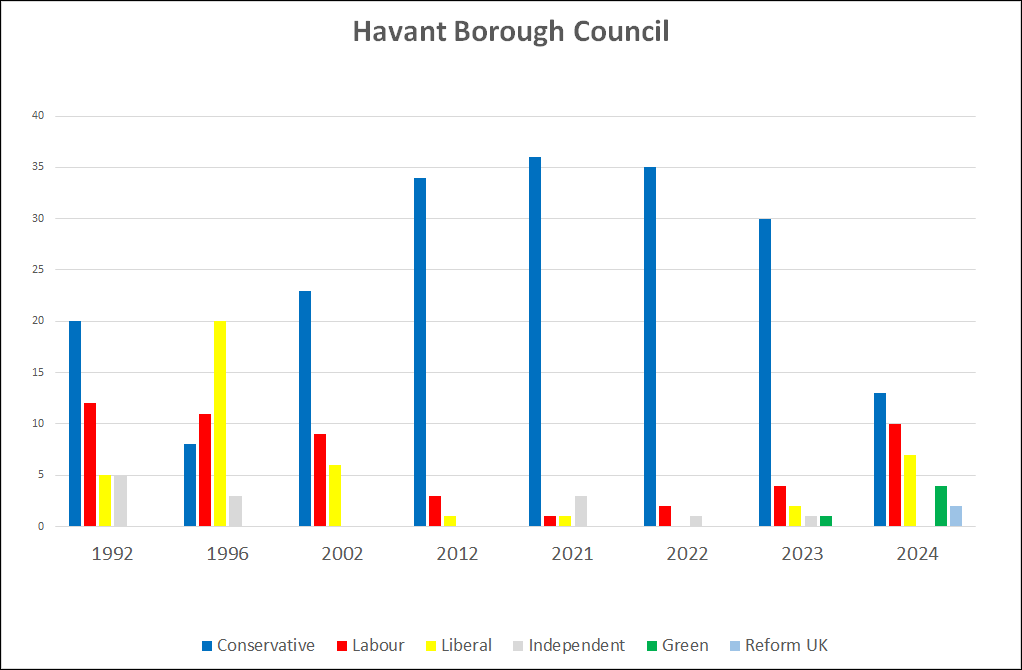
For the past twenty years, Havant has been described by some as a ‘single party state’, ruled by an increasingly tired and indifferent set of Conservative councillors, many of whom had been in post for the duration.
Last week’s welcome but slightly unexpected restoration of balance was the result of years of sheer hard work by the new intake of councillors and their supporters. Many had been actively campaigning and engaging with social media, slowly building credibility online with the increasingly frustrated electorate. The tactic seems to have worked and the local Conservative organisation either failed to turn up or had taken its eye completely off the ball. Failure to learn the lessons from this local election might well see another memorable result for Havant at the General Election. If, however, they simply blame the local results on their own turmoil at Westminster, they will be overlooking the reality that much of last week’s result can be put down to the lacklustre performance of their previous majority and the party-political naivety of the man they put at the helm.
The ever-present threat
The real winners of the election by a ‘country mile’ in all wards were the disengaged, and therein lies the catch, the slumbering threat that all members of the new council need to be mindful of as they move toward future elections.
The following chart is worth mulling over, so click the image to enlarge it and zoom in. It shows the cumulative vote by party (colour) within each ward, with the long grey shadow of the non-voters on the left of each plot. The evidence of tactical pre-election deals is there to see, but so is the Conservative folly of standing more candidates than necessary in some wards, splitting their own vote share. This was a fascinating result and one which has provided opportunities for the borough, providing that the Green and Reform members put the needs of the borough ahead of attempts to make political mileage from their potential numerical advantage.

The success of the opposition parties’ pre-election tactics was compounded by the self-destructive behaviour of the local Conservative organisation which might have had greater success by fielding fewer candidates in targeted seats. For an example of the collateral damage from this approach, you need look no further than Emsworth, where the loss of Cllr. Richard Kennett has deprived the depleted Conservative ranks of one of its sharper and more articulate members. There are hard lessons which must be learned as they regroup to rebuild their base.
All of the parties now represented on the Council need to start listening to the disengaged residents, the grey non-voters on the chart. General disinterest in politics by the many has been matched by exhaustion and frustration in the few of us who run residents’ groups and attempted to engage with the previous Council. We’ve been cynically dismissed or ignored when making deputations to Council and Cabinet meetings and treated with complete disdain during deputations to Committee meetings. It is a sad fact that during the course of Cllr. Rennie’s tenure as Leader, those behaviours have led to the disappointing closure of some of the once-active residents groups, their officers giving up, tired and frustrated. Both sides of the council need to re-engage with the wider body of residential council-tax payers, not to mention the small, independent businesses.
The outgoing Council – End of term report
Without any effective opposition, the majority of the council members had been sleepwalking through council activities for some years, leaving the Cabinet to make far-reaching and questionable decisions unchallenged. Under Cllr. Rennie’s leadership, the cabinet had exploited the weakness and complacency of its majority though its appointments to the Planning Committee, forcing through a number of costly, ill-judged and at times personally-motivated development decisions, suppressing any real challenge. New directions on enforcement being offered by the senior officers are welcome, but the real drive has to be towards prevention and that’s where lower costs and greater efficiency and productivity will be found.
The lack of challenge on planning has been blindingly obvious to the increasingly frustrated residents, exposing serious shortcomings with processes at both Havant Borough Council and Hampshire County Council. These are failures which have left favoured developers to profit at the expense of the borough.
The outgoing Leader – End of term report
Forcing through Cabinet decisions with critical information deliberately withheld from the elected back-bench councillors was the risky strategy that helped bring down the previous leader, Cllr. Wilson. Ironically, it was Tim Pike, the former St. Faith’s ward councillor, who stressed this point in his deputation to the Extraordinary Cabinet Meeting of 19 November 2020, which had been called to ratify the sale of the last piece of real estate of any consequence owned by Havant borough at that time.
It’s worth reading the HCS report of that meeting and watching and listening to the video, listening closely to the former councillor’s deputation. Take the link highlighted below:
The HCS report from November 2020 – Brockhampton West – Selling off the family silver again?
The Brockhampton West site was subsequently sold off by HBC to Clowes Developments for £9M, financing the Council’s purchase of the Meridian Centre and the Bulbeck Road car park. Despite the subsequent planning approval for the development of a distribution park on the site, no action has resulted and Brockhampton West is now earmarked for the development of Southern Water’s controversial Water Recycling Plant. Clowes stand to make a tidy profit in compensation should Southern Water’s Development Control Order be approved by the Secretary of State. (Another Potash Terrace, for those with long memories.)
Within a few months of that meeting, the leader of the Council stepped aside and Cllr. Rennie was appointed in his place, much to the surprise of many in the town given his curiously accelerated career progression. It had been just three years earlier that Alex, as the first of Alan Mak’s parliamentary office staff and protégés to be appointed to the Council, had been put on the ticket as the Conservative candidate in Bondfields ward.
With Cllr. Rennie at the helm, Tim Pike was restored to the Cabinet Regeneration and Economy portfolio where he conveniently forgot the concerns he’d raised over cabinet secrecy, pursuing his own agenda for both the Regeneration and the Economic Development briefs behind closed doors and exempted documents, unchallenged and probably uncontrolled by the hapless Cllr. Rennie.
The predictable failures of the regeneration and economy initiatives happened on Cllr. Rennie’s watch as Leader, including the unsuccessful bids for Levelling up funding, the failure to secure options for development at Dunsbury Park in the event of Freeport non-delivery, and the consequent forcing through of the Amazon project. The rushed acceptance and approval for the planning applications for at 32 New Lane, now known locally as Pike’s Folly, positively reeked of pre-determination and should have been far more closely overseen by the Leader, his cabinet and the monitoring officer.
The Planning Inspector’s rejection of the Local Plan in November 2021 was also on Cllr. Rennie’s watch, as was his failure to notice that the latest attempt to draft a Local Plan – ‘Building a Better Future’ – was failing to build on engagement with the local residents’ groups.
The second member of Alan Mak’s office and Cllr. Rennie’s business partner, Imogen Payter, made her debut on the Conservative St. Faith’s ticket at the 2021 elections. Cllr. Payter’s early enthusiasm in the role was sadly not sustained and for much of the past year she’d been conspicuously absent and unresponsive to constituent’s emails, a record which probably contributed to the collapse of her party’s support in St. Faith’s.
Cllr. Payter’s first and probably last election at Havant Borough Council was preceded by the HCS ‘Lockdown Hustings’ in May 2021. Here’s a brief clip showing first the winning candidate and then the losing Labour candidate. I make no apology for my lockdown hairstyle.
The Conservative organisation in Havant would do well to reflect on the pledges made by Ms. Payter to the voters and compare them to her actual record of achievement while in office.
The following year, in 2022, Cllr. Rennie’s record as Leader contributed to Phil Munday’s overwhelming win in St. Faith’s. Then in 2023, Cllr. Pike lost heavily to the incoming Cllr. Harris and just last Thursday, the newly-elected Cllr. Berwick saw off the competition for a seat that Cllr. Payter had been ‘missing in action’ from for months. Prior to Cllr. Rennie’s term as Leader, nobody would have put money on St. Faith’s ever being a Labour stronghold.
The former leader’s lowest point in office will remain, for me and for many across the borough, the Full Council meeting of March 2022. It was a meeting that did little to further public support and respect for him, or indeed the party that put him there and the record speaks for itself – see the following link:
The HCS report from March 2022 – The ‘Half-Full Council’ – the HBC leader’s ship sinks lower
Looking to the future
As we await the ‘plume of white smoke’ from the Plaza with the announcement of a new Leader, it’s worth reflecting on the challenges facing that role. The combined opposition parties must draw strength from their differences and work together to build what might be termed a ‘council of local unity’. If the lack of overall political control doesn’t spark short-sighted and ill-considered minority alliances, Havant now has a real opportunity to build a better future.
The new executive management team under Steve Jorden is already taking positive steps to overcome the legacy of the previous East Hants alliance and we now have a broad-based and engaged elected council to oversee the changes which must be made. There’s much work to do and it’s going to take time for the new members to get up to speed with essential basic training before getting down to debating, moulding and approving the recommendations handed down by the Management Team.
The HCS website is now into the seventh year following its relaunch and for the first time we can see a positive future for the borough. With political balance restored, the dead wood removed and a group of new, enthusiastic and passionate councillors in place, I’m looking forward to giving my pen a rest for a while and it should be said that I, for one, look forward to the Conservative organisation picking itself up and learning the serious lessons of its failings, both nationally and locally. We need leaders who can bridge the gaps between left-of-centre social policies and right-of-centre economics. A bland compromise won’t hack it.
Perhaps – deep breath – the time has finally come for proportional representation?
As for Bulldog Political Consulting, I wish them the best for the future, whichever flag they’re working under.

 Havant Civic Society