
The brief video below was sent to Havant Civic Society by a resident of Crossland Drive. We passed it on to the management team at Amazon DPO1, the local ward councillors and the Hampshire County Council cabinet member for Highways, on 1 February 2025, for review and response as a matter of urgency. More than two months later, we have still not received any explanation for the drivers’ behaviour, despite this type of complaint having been raised repeatedly through the Amazon Community Liaison Panel since the site began operations two years ago.
Be warned, some of the language used in the clip may offend. It does, however, clearly demonstrate the level of frustration felt by this local resident, fed up with the ongoing antisocial behaviour of delivery drivers working from the Amazon DPO1 site in New Lane. He is not alone and we feel that they deserve a straight answer to the question of what exactly is going on.
Since the company and the local authorities appear unable or unwilling to explain what’s going on, and since there are, almost certainly, other streets in the borough on which similar behaviour is observed, we’ll give our own explanation and invite Amazon to correct anything where we might be mistaken, and invite the local authorities to explain what enforcement action they’re going to take.
For the convenience of readers, text in this colour has been emphasised to better explain the role and function of Amazon’s DPO1 facility at New Lane within the company’s national logistics model.
Here’s what we know
The seven vans in this clip, six of them dark grey Amazon branded vehicles, are parked illegally on the shared pavement and cycleway on the south side of Crossland Drive, in clear view of the Amazon delivery station but away from its on-site cameras.
The video shows coloured fabric ‘totes’ being redistributed by van drivers employed by the Delivery Service Partners (DSPs) who deliver your Amazon packages. Not shown in that video but often seen being shared around in this way on local streets, are the bulky items which don’t conveniently fit in Amazon’s delivery totes, everything from garden rakes to televisions.
The pre-sorted totes and the oversized deliveries arrive at DPO1 in HGVs like the one seen here, blocking New Lane outside the NHS Elmleigh hospital for three hours in January, having run aground on the grass verge after, we believe, taking a wrong turn into Sumiko Polymers. We’re still awaiting an explanation of that incident and are also curious to know why the driver was travelling northward from Eastern Road.
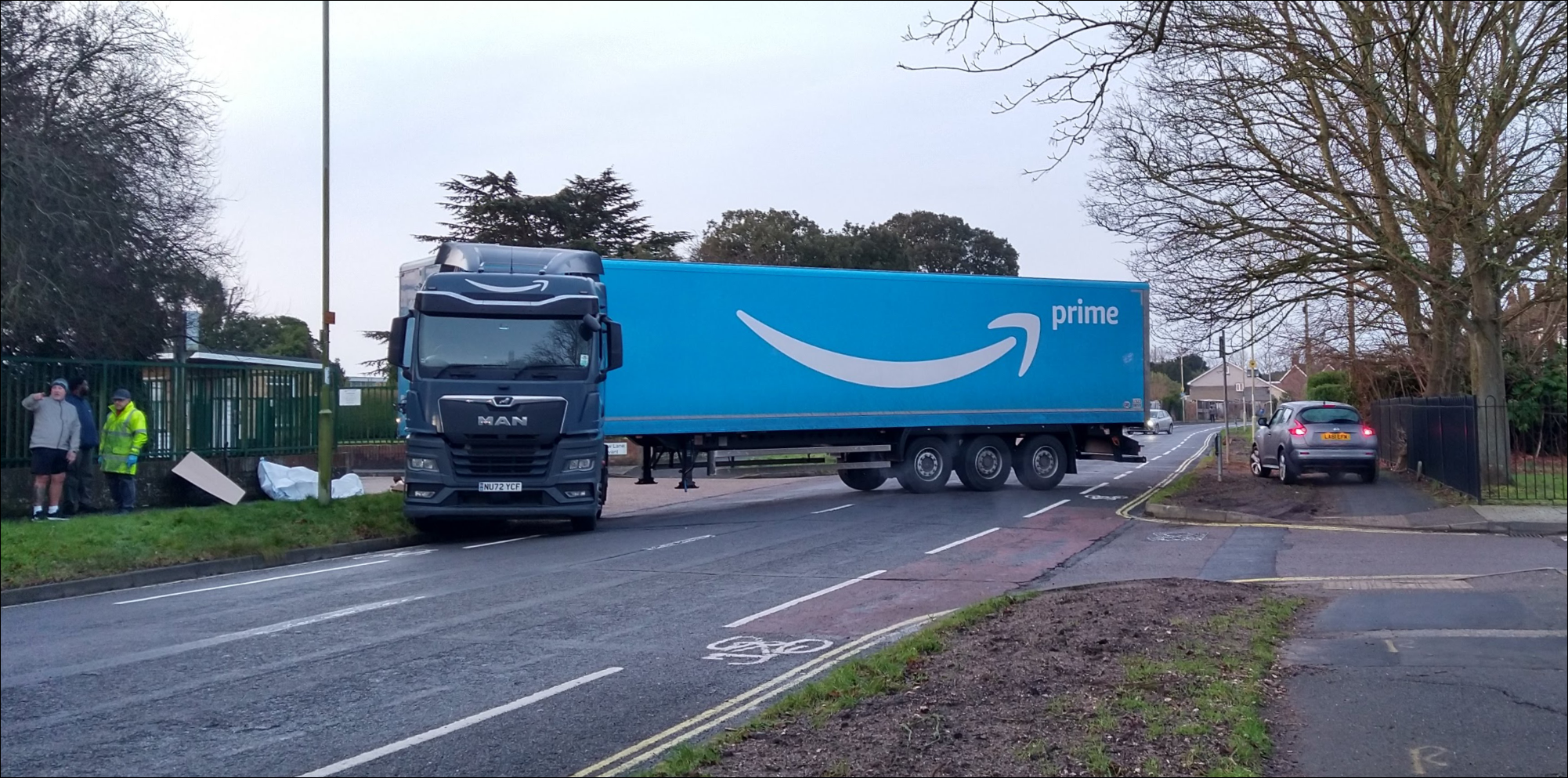
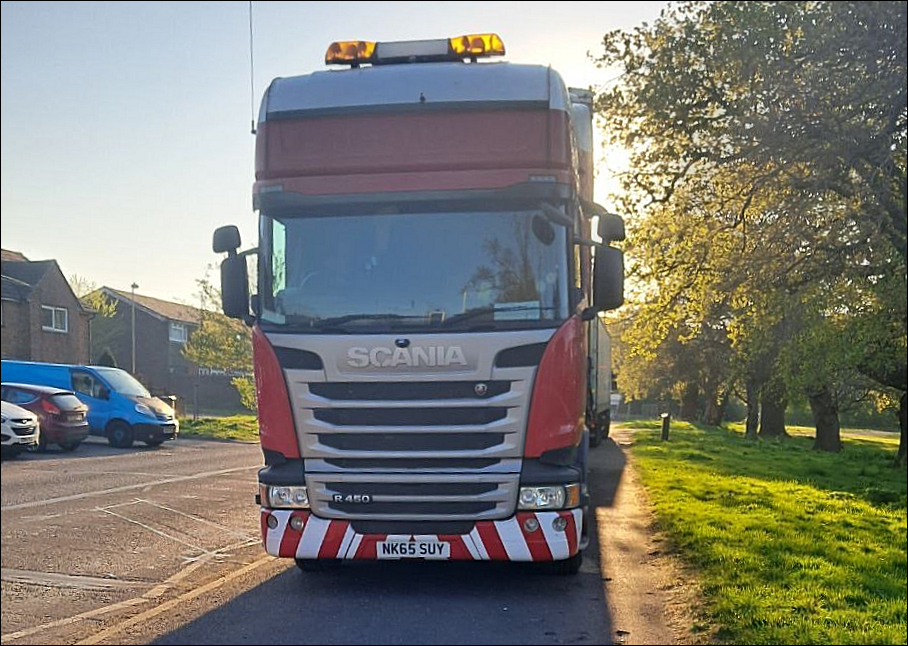
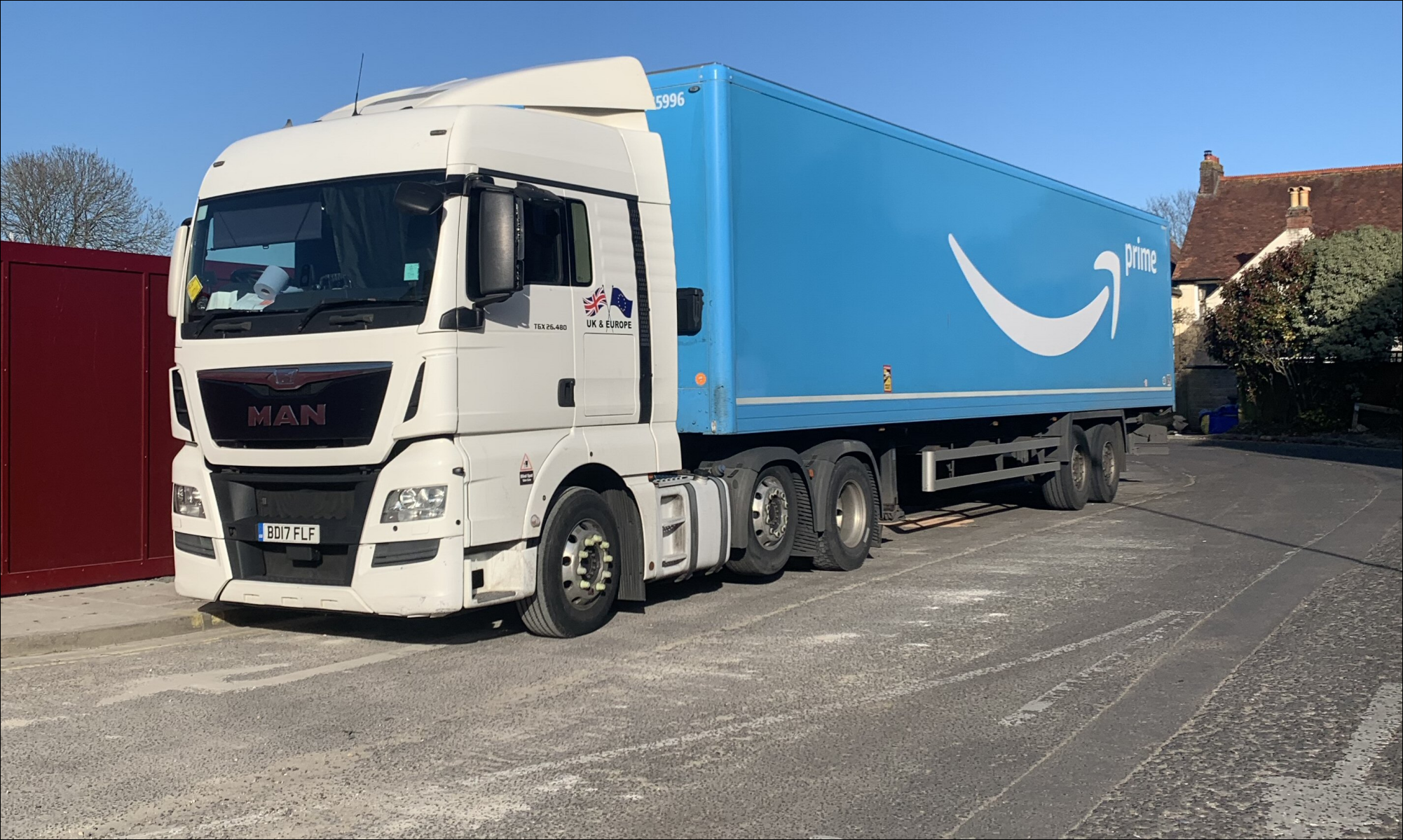
Despite the Amazon branding, these HGVs are owned or leased by third-party contractors, pulling both the branded and the unbranded trailers which haul customer deliveries into DPO1 from Amazon Fulfilment Centres and Sortation Centres located around the UK.
The sorting of those totes into delivery urgency, ‘same day’ or ‘next day’, will have already been performed at ‘upstream’ logistics centres. In its current operating mode, the New Lane DPO1 services ‘next day’ deliveries for end user business and consumer customers located in a broad swathe from the eastern side of Southampton to the Chichester area and covering the area around Alton and Petersfield to the north. Totes destined for ‘same day’ deliveries for the same customer area currently being handled by either DBN5 at Bersted or DSO2 at Totton.
Confused by the Amazon site codes? Well, the first letter ‘D’ denotes a ”delivery station’. The second and third letter denotes the primary delivery area, so ‘DPO1’ is Portsmouth, ‘DSO2’ Southampton, ‘DBN5’ Brighton, ‘DBH3’ Bournemouth and so on. The number on the end simply identifies multiple delivery stations servicing the same primary delivery area, so DBN5 is at Bersted, on the outskirts of Bognor, replacing the previous DBN2 location at Littlehampton. Isle of Wight deliveries are currently routed through Southampton and distributed by a third party logistics partner at Newport.
Just for fun, open up Google Earth and see if you can find the first one, DPE2, and another smaller one at DHU2. These were the first two sites at which we identified the distinctive architectural footprint of the much larger DPO1 in Havant, long before it was built.
Many ‘linehaul’ HGVs are now using town centre streets as lorry parks, often overnight and sometimes all day long. That same stretch of shared pavement/cycleway in Crossland Drive is regarded as a convenient spot. One vehicle has even been spotted parked all day at the old Bulbeck Road car park site, though if you look closely, you’ll see that they found a parking ticket on their windscreen.

As HCS first disclosed in 2021, this purpose-built Amazon delivery station was designed to be the largest of a new breed of delivery stations with multi-storey van parking; ‘MSVP Delivery Stations’. The New Lane DPO1 facility was also the first to be designed and constructed with twin van access points, enabling simultaneous van despatch from both the north and south entrances. These MSVP delivery stations are designed to maximise space efficiency by using multi-storey facilities for both van parking and loading. Reading between the lines, they provide the opportunity to expand the number of van loading bays under permitted development rules, exploiting the unused spare volume within the oversized distribution building.
Two years into site operations here in Havant, there is no sign that the MSVP is being used, so there’s nothing but tumbleweed blowing around on its upper floors. As soon as Havant Borough Council’s Planning Services permit the clock to run down on the planning condition for traffic monitoring, we can expect that the site will ratchet up closer to its designed capacity and the good folk of Crossland Drive will be the first to bear the brunt.
Operations at each of these delivery stations can be reallocated or fine-tuned at very short notice as the company reacts to variations in demand and local circumstances. Redundant capacity is designed into the entire network to ensure that customer deliveries can be maintained, for example, in the event of unscheduled industrial action at an Amazon site or a major disruption event on the strategic road network. This means that sites like DPO1 will not normally operate at their full designed capacity. However, if the workers at Totton or Bersted should ever rise to industrial action, then DPO1 would immediately ramp up to meet the demand.
So how does DPO1 work?
DPO1 is unusual, having been designed for Havant’s edge-of-town employment estate at Dunsbury Park but having been shoe-horned for purely political reasons into the former town centre Havant North industrial estate. The political fly in the ointment five years ago had been that Portsmouth City Council, who own Dunsbury Park, and Havant Borough Council, who collect the business rate income, had collectively fallen for the previous UK Government’s ‘Freeport dream’. They already had one last-mile delivery centre at Dunsbury Park with DPD and they weren’t going to allow another.
The site operations are straightforward, the receiving and despatching deliveries to customers. Inbound HGVs arrive around the clock from the upstream ‘fulfilment’ and ‘sortation’ centres and unload at the twelve HGV bays at the rear of the building. Their pre-sorted loads are optically scanned and split using a network of conveyor belts before the sorted delivery loads for individual vans are placed into wheeled cages by a small number of manual shift workers. The cages are moved to the seventy-two outbound van loading bays to await the arrival of the incoming wave of empty vans.
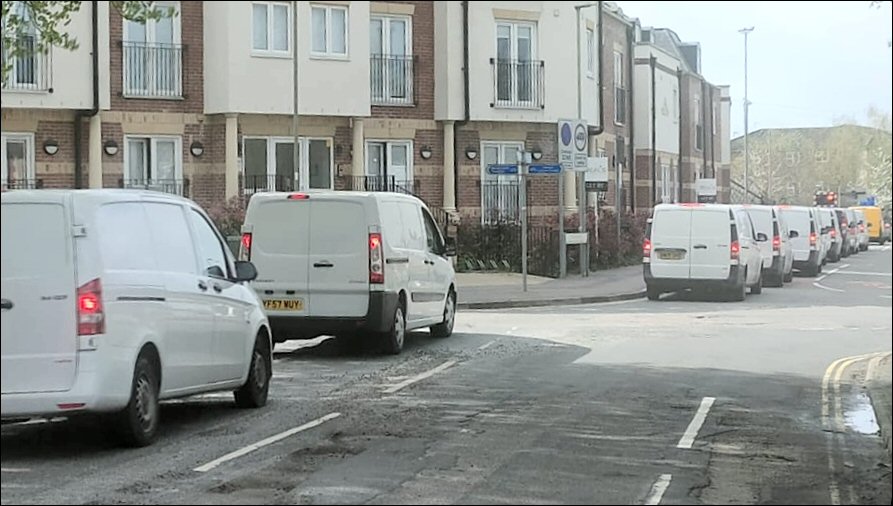
To ensure smooth operation at DPO1, the van movements in and out of the site are scheduled in waves, with those which arrive in the area early parking up on local streets to wait for their scheduled arrival time.
Once checked in, the van drivers head for their designated loading bay, grab their cages, load their vans with their totes (and any oversized packages for their route) and exit the site without further delay. This takes a matter of minutes; time is of the essence. The empty cages are then wheeled back into their positions next to the computerised conveyor belts ready to load the next wave of outbound deliveries. This cycle is repeated several times throughout the day, with several waves of arriving and departing vans regularly observed.
In the afternoons, and on into the early evening, a steady stream of vans and other owner-driver private cars, can also be seen arriving at the site, picking up Amazon Flex delivery loads, and departing.
It’s a straightforward model, but one highly reliant on precise scheduling and advanced logistics technology. Amazon has made it clear at a global level that they aim to replace the current low-cost, mostly out-of-area workforce of its delivery stations by increasingly automated operations.
So why all the shuffling of totes outside your houses?
Amazon’s internal systems are clearly not able to fully optimise delivery loads for conditions at the destination delivery station, leading to the need for the type of off-site interventions by van drivers which are shown graphically in the video. You might ask, why don’t they simply allow the drivers to use the empty floors of the MSVP to do this additional level of sorting? The reason, we think, is probably twofold, firstly that the Company needs to get the loaded vans off the site as soon as possible to make way for the next incoming wave of empty ones. It’s also likely that the DSP drivers do not want to be seen doing this under the gaze of the site security cameras; it must be far easier to do it on the public highway where there are no cameras and little chance of being challenged.
So who owns and drives those vans?
Those with long memories will recall Amazon’s representatives, Chris Fry and Natalie Fellows, supported by the officers present, painting a convincing picture to the HBC Planning Committee of their ‘intended occupier’ for 32 New Lane using a ‘wholly owned fleet of branded delivery vans’, stored and loaded onsite overnight in the multi storey van park. That misrepresentation was exploited by HBC Planning Services to withhold essential information, ensuring Amazon’s anonymity and expediting the approval of the planning application, despite the protestations of the better-informed public.
At the time of the planning application, the reality was that there were at least four types of ‘last mile’ delivery vehicles, none of them owned or operated by Amazon, that were intended to perform final deliveries to customers from the DPO1 facility. These are:
| Unbranded ‘white van’ owner/drivers operating under ‘Amazon Flex’ terms |
| Unbranded Delivery Service Partners operating under ‘DSP 1.0‘ terms |
| Amazon branded Delivery Service Partner vans operating under ‘DSP 2.0’ terms |
| Private cars and vans used by self-employed individuals under ‘Amazon Flex’ terms |
The unbranded, usually basic white delivery vans, are either leased by ‘DSP 1.0’ partners or run by individual ‘White Van’ owner/drivers, operating under Amazon ‘Flex’ terms and in either case, driven by self-employed drivers on gig-economy terms. ‘DSP 1.0’ Drivers either own their vans or rent them from their DSP, with rental costs typically deducted from their wages. They are responsible for their own fuel costs, but they receive a mileage reimbursement to offset these expenses.
The dark grey Amazon ‘smile’ branded vans are leased by ‘DSP 2.0‘ partners, who have a rather closer commercial relationship with Amazon and can use supporting technology supplied by the company. While Amazon provides the vans and covers certain expenses like fuel costs, these DSPs are responsible for other ongoing costs such as vehicle leases, maintenance, and damages. This means that while DSPs benefit from using Amazon-branded vans, they still have financial responsibilities related to the vehicles.
As direct employees of the Delivery Service Partners, the DSP 2.0 drivers do have some legal rights, for example to sick pay and holiday allowances. The Delivery Service Partner is responsible for its fleet of Amazon-branded vehicles and manage the associated costs, including maintenance, insurance, and fuel.
If that’s already confused you, there’s another level of driver, the Amazon Flex driver. As the term suggests, these are the gig-economy workers who cater for the volume spikes and local anomalies; private individuals using their own cars and vans to deliver loads direct from the delivery stations to you, the customer. The Flex driver bids for available ‘blocks’ of deliveries, with rates varying according to the urgency of the job, including cleaning up the mistakes and re-deliveries at short notice. It’s unreliable work, with far more signed up Flex drivers than available work, but like Deliveroo, Just Eat, Uber and the myriad of other gig jobs, it seems to fit the growing demand by people to work on their own terms.
Where does this leave us?
The behaviour displayed in the earlier video is almost certainly being witnessed in other parts of the borough, as vans head through local streets to the A27 and the A3(M). Until now, we’ve witnessed it most often with a smaller number of mostly unbranded (DSP 1.0) vans around St Albans Road and the Eastern Road cul-de-sac, but the video in this post now shows it happening more conspicuously with ‘Amazon’ branded (DSP 2.0) vehicles.
If you’re seeing this behaviour on your own streets, please take this link to email us and we’ll ensure that the word is passed to the Amazon Community Liaison Panel (CLP). All they need is the street or the postcode, and if possible, the registration numbers of the vehicles. Please be assured that your anonymity will be respected.
Local Amazon management has previously expressed surprise at these complaints, but it is common knowledge that DSP drivers often re-sort their vans after leaving a delivery station to re-pack their loads, optimise their delivery routes, correct for errors in the delivery station sort process and account for local traffic conditions. While Amazon have the systems expertise at the national and regional legs of the delivery process, it is likely that the DSPs would prefer to use and follow their own systems and routing at the local, final delivery stage, leading to the kind of multiple vehicle load optimisation that is evidenced in the video.
Amazon site management have previously told the CLP that drivers are welcome to use the otherwise empty MSVP van decks for this activity, although to be honest, this is an unlikely scenario. The Company needs loaded vans to vacate the site as soon as possible to make way for the next incoming wave of empty vans, and the DSP drivers would far prefer to re-sort their loads away from the watchful eye of the DPO1 CCTV systems. This process should be enshrined by HBC Planning Services in the increasingly obsolete Operational Management Plan. That document was created in response to a condition of the planning application that has never been enforced.
The requirement for efficiency in delivery loading at DPO1 means that time spent on site by any van has to be minimised.
As customer order volumes grow and demand for faster delivery increases, the number of van loading bays is likely to be increased through permitted development on the upper floors of the MSVP, and the number of traffic movements generated by the operation will inevitably rise. The volume of traffic will inevitably increase and with it, the collateral impact on the surrounding residential streets.
We believe that the local authorities, having permitted its construction at this highly inappropriate site, must now take firm action to ensure that the growth of traffic generation at the site is both monitored and managed.
That monitoring activity must be the responsibility of the county highway authority, in close conjunction with National Highways, the strategic road network authority who were inexplicably excluded from the original development plan consultation.
 Havant Civic Society
having read this my sympathies go out to the residents in the area, the traffic alone must be horrendous let alone the drivers parking on the roads to organise the delivery items, someone is just turning a very unfair eye and have very slopepy shoulders
I stood on the corner of Town Hall road by the Spring art centre and counted 17 white vans coming out of town hall road, obviously they were eating for a train to go through.
we as residents have in our area have been successful for now in objecting to a School for SEN children , nothing against the children but the impact of the taxi’s dropping off and picking up would have been rediculous.
It is about time HBC thought about the residents who’s homes are so badly effected.
I do hope you can get some support and help to rectify the awful situation you have been put in.
LikeLike
While waiting for the Planning Department to get its act together, why isn’t HBC sending Parking Enforcement to Crossland Drive every morning to hand put parking tickets?
LikeLike