
If you’re a regular reader of the HCS blog, you’ll be aware that major commercial planning applications invariably come with supporting documents from planning consultants. For large applications, transport-related documentation forms the core of the supporting material.
Recent experience has suggested that this documentation is often used to argue, through countless densely printed pages and appendices, that the traffic generation relating to the occupation of a proposed new development will be no greater than that generated by the previous occupant of the site.
If the planning consultant can successfully sell this claim as a fact to planning officers at Havant Borough Council (HBC) and Hampshire County Council Highways’ (HCC), then their objective of securing a recommendation for approval becomes significantly easier.
In this post, we take a look at the planning consultants’ use of the ‘Trip Rate Information Computer System (TRICS)’, an estimating tool owned and endorsed by a consortium of local authorities including Hampshire County Council.
The tool serves two complementary objectives, aimed at two distinct user communities; the planning consultants who create transport statements and assessments, and the local authority planning officers, whose responsibilities include the thorough scrutiny of transport documentation as part of their assessment and decision-making process.
The TRICS Good Practice Guide makes the distinction between the two processes clear:
“TRICS is a very flexible system providing a large amount of survey data across a wide range of development types, therefore allowing great potential variation in the calculation of both vehicular and multi-modal trip rates. Therefore, it is quite possible that two users of the system, applying different filtering criteria and ranges to a task, may end up producing different results. This guide is intended to assist users in ensuring that correct procedures and understanding of the system are practised in the production of trip rate calculations and is also intended to provide guidance to assist in the correct and thorough auditing of TRICS data once it is received by third parties.“
Like any other such tool, the quality of the TRICS output is directly proportional to the accuracy and validity of the data input. The TRICS Good Practice Guide warns against biased or misleading trip rates and highlights the need for cross-testing and representative sample sizes. If incorrect input parameters are used – such as unrealistic land use definitions or manipulated trip rates – the results can be skewed, leading to unreliable transport assessments.
HCC, along with Dorset, East Sussex, Kent, Surrey, and West Sussex county councils, jointly own and draw income through TRICS Consortium Limited from licencing the toolset to planning consultants. However, in the case studies outlined below we find no evidence to demonstrate that HCC Highways planning officers have been consistent in carrying out the ‘correct and thorough’ audit on transport assessments which is recommended by their own consortium. This potentially exposes a significant weakness in the two-tier local authority planning process, calling into question the credibility of the Havant Borough Council (HBC) planning officer’s recommendations to a Planning Committee.
Here are three examples of the issue evidenced in three planning applications, two historic, one current:
8 Downley Road – The redevelopment of the Dunham Bush site
You may recall our recent report of the Planning Committee meeting which approved the construction of a new warehouse/distribution centre on the former Dunham Bush site at Downley Road.
Rather than researching the actual traffic profile of the site’s previous occupant, the planning consultant relied on a favourable estimate, generated by providing appropriate input parameters to TRICS.
The traffic generation for the new development at 8 Downley Road was predicted to be 707 vehicle movements per day. The daily total for the previous occupancy by Dunham Bush had been derived from the TRICS toolset to be 745, demonstrating that the new development would result in a decrease in traffic generation of 38 vehicle movements per day.
However, had the planning consultant done the relevant basic field research, they would have found plenty of former Dunham Bush professional staff in the town who would have provided quite different and more accurate observations. The inconvenient truth was that activities at Dunham Bush generated a maximum of no more than 200 daily movements, including bicycles, throughout the last decade of that company’s occupation.
The planning submission therefore appears to have conveniently hidden a real net increase of more than 500 vehicle movements per day.
32 New Lane – The redevelopment of the Pfizer site
The planning submission for the highly controversial redevelopment of the former Pfizer cold chain warehouse at 32 New Lane also used TRICS algorithms to misrepresent previous traffic generation at the site.
Take note of the highlighted text in the following extract from the planning submission for 32 New Lane:
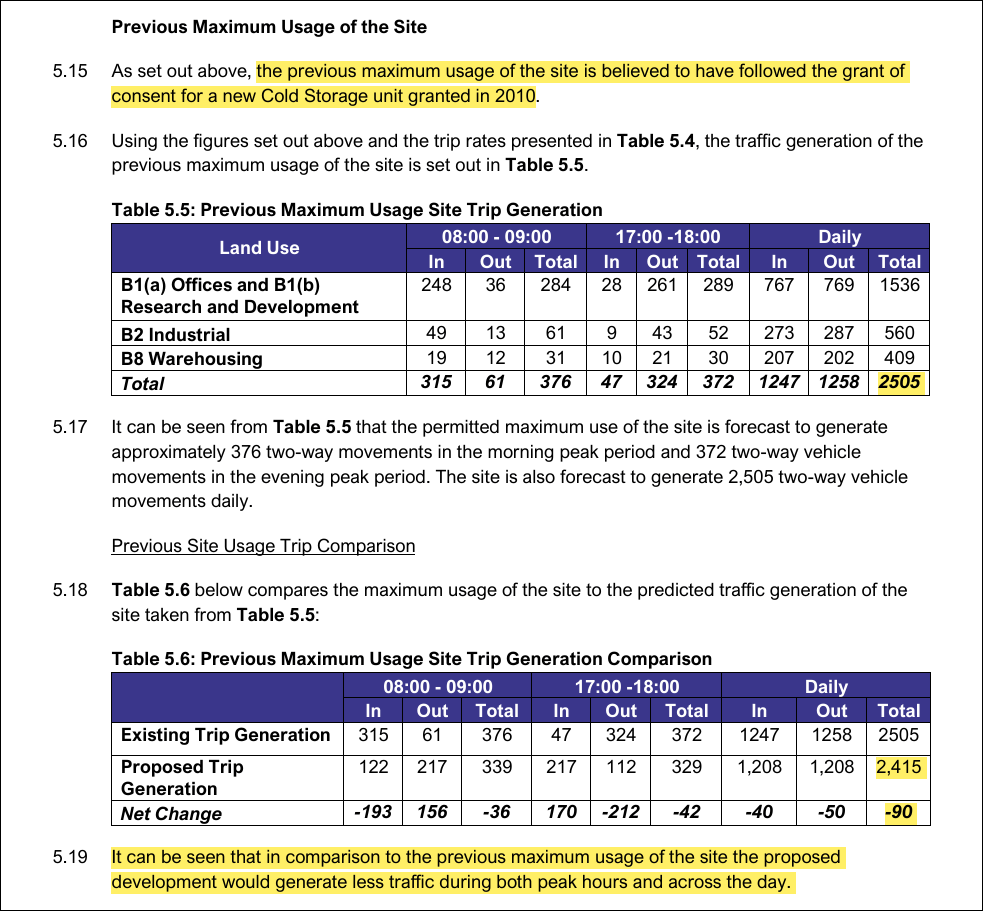
In the absence of any demonstration of thorough analysis by the local authorities, the public protestors had focussed on the inaccuracies and ambiguities in the predicted future traffic generation on the understanding that the ‘previous maximum usage‘ under Pfizer’s occupation had been audited and agreed by the HBC and HCC planning officers.
However, upon closer examination of the transport consultant’s statement that “the previous maximum usage of the site is believed to have followed the grant of consent for a new Cold Storage unit granted in 2010,” we are now astonished by the apparent ease with which the local authority planning officers could and should have challenged this at the pre-planning stage.
The facts were readily available on the HBC Planning Services database, as the following extract from the Transport Assessment which accompanied the Pfizer Cold Store planning application in 2010 reveals:

In that document, Pfizer’s daily traffic generation had been derived from the company’s own gate security records and showed a daily trip generation of around 47 + 40 + 250 = 337 movements per day. That falls far short of the 2,505 movements reported by Amazon’s transport consultant. To save you the maths, the consultant’s TRICS-sourced estimate for previous traffic at 32 New Lane was a staggering 750% higher than the actual previous figure.
By disregarding the evidence publicly available on the planning file and using TRICS to generate an ‘acceptable’ figure, the planning consultants engaged by Amazon appear to have hidden a very real proposed increase of more than 2,000 vehicle movements per day while presenting an estimated decrease of 90.
Hampshire County Council Highway’s failure to expose this most basic trip rate manipulation was compounded by the planning officers’ failure to also recognise that the predicted, post development traffic profile was completely at odds with Amazon’s well-publicised operational processes.
The identity of the ‘intended occupier’ was well known to the council but had been withheld from the public and from the Planning Committee , despite its crucial significance to the decision-making process. The architectural design shown in the supporting documentation had already been shown by HCS to have the unmistakeable characteristics of the large, bespoke out-of-town Amazon delivery station that it has proven to be.
Current planning applications continue to highlight shortcomings in local authority oversight of transport documentation
A case in point is the disputed planning application for Portsmouth Water’s proposed new Solent Road headquarters. The planned access route poses serious risks to the safety and wellbeing of NHS facility staff and patients as it would remove the protective space currently provided by their dedicated site access and turning area.
While the healthcare facilities have been ignored by both the applicant and the local authorities, the Bosmere Medical Practice Patient Participation Group (PPG), supported by HCS, has been highlighting the issues on their behalf since October 2019.
Portsmouth Water’s planning consultant and the HCC Highways planning officer have both dismissed essential vehicle movements at the NHS facilities as trivial and irrelevant, while HBC Planning officers have remained silent.
The most pressing inadequacies of the planning consultants’ documentation are highlighted in two letters addressed by the Bosmere Medical Practice PPG to the local authorities.
The letters can be read by selecting the following links:
| Letter to Hampshire County Council Highways planning, 26 March 2024 |
| Letter to Hampshire County Council Highways planning, 19 April 2024 |
No satisfactory response to these letters has been received.
The viability of the transport data provided with this planning application, once again generated using TRICS, has raised serious questions from the outset. The original evidence base underpinning the planning application was derived from a six-hour traffic survey carried out during the Covid pandemic in November 2020, four days after the Prime Minister had announced the second national lockdown. The recorded data, far from being representative of normal trip generation, was uplifted using a highly questionable ‘Coronavirus factor’, based on an inappropriately located traffic counter.
The fact that the ‘amended’ Transport Assessment, submitted with the resubmitted planning application in July 2023, relied on the original November 2020 evidence base is highly concerning. The data was outdated, inadequately constructed, unrepresentative, and, most critically, incomplete.
Six years after the initial concerns were raised, this planning application is now being rushed towards a Planning Committee decision with unexplained urgency.
The staff, the 20,000 patients on the medical centre’s NHS list and the local care homes which are reliant on the operations at the pharmacy will all be looking to the Planning Committee to challenge the material presented.
These TRICS have been played on the Planning Committee before
The three cases highlighted in this post involve planning consultants who report to the same large planning consultancy.
It is also worth noting that the same consultancy is continuing to provide the ‘independent’ traffic management reporting which was conditioned by the development approval for Amazon’s occupation at 32 New Lane. These reports, together with the non-compliant Operational Management Plan which serves as their reference base, have been regularly challenged by local resident members of the Amazon Community Liaison Panel. Unchallenged by HBC officers, these reports have been created by the very same transport consultant who used TRICS to compile the ‘previous (Pfizer) traffic generation’ data quoted earlier.

. . . . . . .
Wider concerns and further reading
It is widely accepted that many UK local authority planning officers move on to more financially-rewarding roles as private sector planning consultants, a national trend which has been observed locally by those who take the time to examine development applications managed by Havant Borough Council Planning Services.
Collaboration between private sector planning consultants and local authority planning officers has the potential to create conflicts of interest, raising concerns among public observers and making it a legitimate concern for scrutiny by a planning committee.
The three documents quoted below provide three different perspectives on the relationship between local government planning officers and private sector planning consultants; the problems sometimes evident in the local authorities which serve Havant are quite clearly common across the UK.

“Almost all (97%) planning departments reported some planning skills gaps. Planning departments’ short-term strategies to address capacity and skills gap issues relied heavily on outsourcing. Departments were most likely to address problems with skills gaps by using agency staff (60%), with half (51%) saying they procured external consultants. Of those with unfilled vacancies, half (52%) reported using agency staff and contractors.”
UK Government MHCLG – Local Authority Planning Capacity and Skills Survey 2023

“… the issue of under-resourcing casts a considerable shadow over the planning profession and the communities it serves. This, in turn, contributes to a decline in public confidence in the efficacy of the planning system. An alarming reflection of this predicament can be seen in the real salaries of town planners, which has experienced a continuous decline over nearly two decades. Further examination of the data demonstrates a concerning trend of public sector planners dwindling in numbers, with over twenty percent of them leaving the public sector since 2010. Conversely, private sector planners have witnessed a notable upswing in numbers, almost doubling during the same period.”
Royal Town Planning Institute – State of the profession, 2023
“Lobbying is when interested parties put forward their views to councillors and officers, which is a healthy part of the planning decision-making process. However, when done behind closed doors and through privileged access, it can lead to the perception or reality that big decisions are distorted in favour of powerful, private interests.”
Permission accomplished – Assessing corruption risks in local authority planning – Transparency International UK
. . .
 Havant Civic Society