
Having spent a lifetime in the IT industry – delivering global business solutions and supporting the procurement needs of both corporate and government clients – the author of this piece regards cyber security and data resilience not as abstract concepts, but as second nature. These principles are the foundation of any credible digital infrastructure and their absence in Havant Borough Council’s business systems is both alarming and avoidable.
Recent disruptions at M&S, the Co-op, and Jaguar Land Rover have highlighted the urgent need for stronger cyber resilience – including the ability to maintain data-driven operations manually while digital systems are restored. In those cases, external threats were to blame. In contrast, Havant Borough Council’s ongoing IT crisis appears entirely self-inflicted. The local authority now serves as a cautionary example of what happens when data resilience is overlooked: a failed planning system upgrade and poorly managed outsourcing have laid bare serious weaknesses in how core services are governed.
Where do we currently stand?
At present, dozens of property transactions across the borough are in limbo because Havant Borough Council is unable to carry out its statutory duty to process property searches for conveyancing solicitors. While this is the most visible consequence, it’s likely just the tip of the iceberg – other serious disruptions are almost certainly unfolding behind the scenes.

Since there has still been no public announcement by the Council of the scale of the problem and all efforts to provide constructive help are falling on deaf ears, here’s what HCS can glean from the evidence so far visible:
We outlined the background to this issue in a previous post, dated 2 October. Since then, the continued silence from Havant Borough Council has been striking. Dozens of prospective house buyers and sellers, frustrated by delays in property searches across the borough, are receiving inadequate responses from the HBC Land Charges Team Leader – who, rather tellingly, appears to be a Capita employee working out of Abingdon, Oxfordshire.
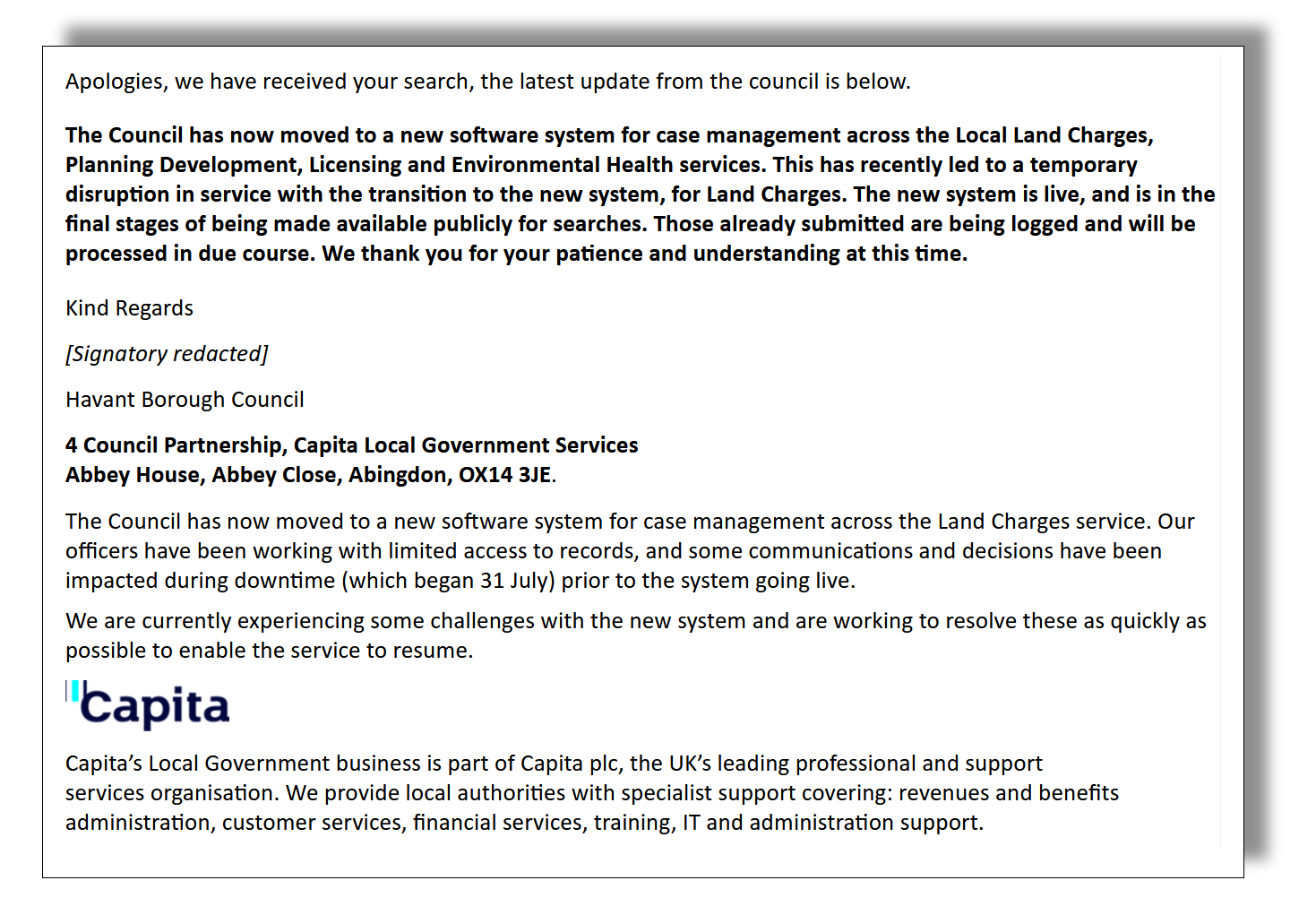
Although Havant Borough Council’s broader outsourcing arrangement with Capita under the ‘Five Councils’ contract formally ended on 31 September, Capita remains responsible for delivering key services – including Revenues & Benefits and Land Charges – under a renewed agreement with the remaining four councils: Havant, Hart, South Oxfordshire, and Vale of White Horse, following Mendip District Council’s merger into Somerset Council.
While council officers have yet to offer any clear explanation, the most plausible reason for the serious issues reported by external users of the new Arcus Planning system is a fundamental oversight: the apparent failure to include the conversion and migration of data in the procurement specification for the council’s new planning system and the apparent omission of consideration of the external stakeholder user requirements.
If our understanding is correct, these fundamental errors are likely to prove both costly and time-consuming to fix. The urgency cannot be overstated – access to historical planning records is essential for the council to fulfil its statutory duties in planning, enforcement, and land charges.
What next?
Once Havant Borough Council’s planning data history is fully recovered, the community deserves a transparent, independent review – led by an external chair, not internal officers. Trust in the Council’s management has been severely undermined by years of opaque decision-making, failed regeneration efforts, and now a planning system upgrade that has gone badly wrong, with no published outlook for resolution.
Havant Civic Society believes the responsibility lies squarely with the Council’s senior management team and officers. Elected councillors should not carry the blame for operational failures they did not contract or control. Outsourcing may have been extensive, but it was the management team’s duty to retain the necessary skills and oversight needed to protect core services and oversee inevitable future procurement requirements.
If no proper plan was in place for migrating critical planning data and local customisation, that would point to a serious failure of competence. Officers are expected to ensure continuity of governance – especially across election cycles, where councillor turnover is normal. Councillors are there to scrutinise and safeguard public funds. They cannot do that effectively if the officer leadership fails in its professional responsibilities.
The Arcus Public Register has now been live for six weeks, yet it remains stripped of historical data and plagued by basic functional flaws, severely limiting its use.
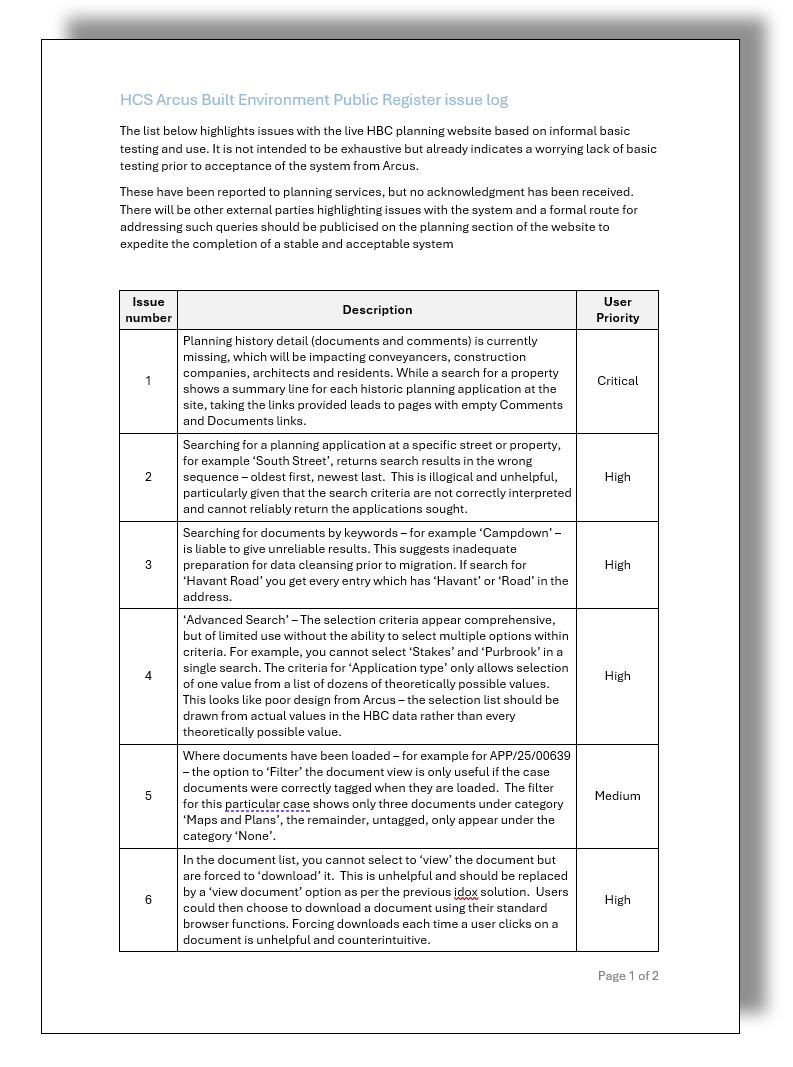
These issues were first shared with HBC Planning Services on 27 September. To date, there has been no acknowledgement, no response, just the customary silence.
This does not leave Arcus Global is a good light either. Quite how a serious player in the UK Government’s digital transformation market would leave a potentially significant reference client in this kind of mess is a question that they’re going to have to answer directly. The system that has gone live to Havant Borough Council’s external stakeholders is hardly a glowing reference for the Arcus Global product.
Residents also need to hear from Capita, on whose watch the decision to select Arcus was made. HCS has raised an Information Request to gain sight of the Full Business Case which informed the previous Cabinet’s decision. The decision to outsource procurement to Capita had been made several years before, one hopes on an understanding that it would be handled professionally.
These failures reflect a serious breakdown in governance, marked by an apparent disregard for the critical importance of data resilience within the Council’s core systems. Equally concerning is the neglect of essential local customisation during the rollout of the new IT solution, compounded by a lack of proper migration planning and user acceptance testing.
Responsibility for this rests squarely with the leadership and senior officers of Havant Borough Council’s management team. Clear answers are long overdue.
 Havant Civic Society