
Why does this post matter?
It matters because Havant Borough’s planning record has been compromised. The HBC Strategic Commissioning Programme appeared to have left the Borough’s planning archive so damaged at the point of the cutover in September 2025 that officers were forced into a series of reactive database ‘fixes’, almost certainly without a coherent audit trail.
The public-facing planning function has been downgraded to a rudimentary, near‑prototype user interface, with little prospect of meaningful improvement before the Borough disappears under Local Government Reorganisation (LGR). Whether LGR proceeds or collapses, the harm to the historic planning record will remain. The inconsistencies and gaps will sit in the system for years, potentially waiting to surface during property transactions and planning appeals.
HCS has been reporting on these issues in a series of website articles since starting our own review of the new Arcus system in September 2025. With major development consultations looming – including 628 homes at Campdown and a further1,800 proposed for Southleigh – the usability and integrity of the systems underpinning public engagement is something that should concern all of us.
This post reports on the Overview and Scrutiny Committee meeting on 18 February, at which further evidence was presented. The ‘internal audit’ currently in progress now has some serious questions to answer. We list a few obvious ones at the end of this post.
The programme’s lack of transparency on value for money is not something that can be brushed aside. Officer time has a real, measurable cost and diverting staff to unplanned work carries consequences. Every hour spent on unscheduled activity is an hour taken away from the work they are actually meant to be doing. Those hidden, unplanned costs are real – and they accumulate.
- Background
- The Strategic Commissioning Programme
- The O&S Committee meeting – 18 February, 2026
- The significance of the ‘MVP’ comment
- Questions for the auditors
- Reference sources
Background
In September 2025, shortly after the new planning system component of the council’s Strategic Commissioning Programme went live, HCS began hearing of complaints that house sales across the borough were stalling because the Council was unable to carry out its statutory function of providing Local Land Charge searches.
A closer look revealed the underlying problem; the entire planning history for the Borough had vanished and with it, the council’s official planning record, including documents and comments relating to both decided and undecided planning applications.
In the weeks that followed, HCS published a series of blog posts based on our own attempts to use the new Arcus system, together with a slow drip-feed of information gathered from Freedom of Information requests. Requests to the council for explanations fell on deaf ears, none were forthcoming.
What emerged was a story all too familiar to anyone in the IT world: the predictable chaos that unfolds when an organisation attempts to bring system support back in‑house after years of outsourcing, only to discover that the essential skills needed to manage critical business change have long since evaporated.
The Strategic Commissioning Programme
The council had outsourced many of the core IT systems which supported its functions back in 2016 in a ‘5 counties’ deal, shared with four other local authorities. The contract was descoped in 2020, but the core services of Planning, Environmental Health, Land Charges and Revenues and Benefits remained with Capita for a further five years, with the contract due to expire at the end of August 2025.
In January 2023, the Council published its strategy to replace its entire portfolio of older ‘legacy’ IT systems with newer, ‘cloud-based’ solutions before the closure of the Capita contract. That strategy assumed (1) that moving to modern “software as a service” systems would be relatively straightforward, (2) that using a single main supplier would reduce risk, and that (3) the change could be delivered by September 2025 without extra cost.
The documentation from 2023 (references at the end of this post) shows that the working assumption was that the new SaaS (‘Software as a Service’) systems were expected to be functionally equivalent, with improved usability and maintainability, and a reduction in the overall cost of ownership.
The full business case for the new ‘Place’ systems even included an additional benefit, from an anticipated freeing-up of planning officer time to support external commercial revenue generation:
It is estimated that once the system is operational it will allow 1 x FTE planning officer time to be redeployed to undertake commercial work at a rate of £500 per day or £115,000 of income over the contract term.
The assumptions proved to be flawed. When the new Arcus system went ‘live’ in September 2025, the new Land Charges service had to be taken offline for several weeks, the online Planning Register was found to be incomplete with thousands of critical documents and comments missing from public view. As we have discussed in earlier posts, it remains a mystery that the Arcus solutions were selected.
Five months later, at the Overview and Scrutiny (O&S) Committee meeting on 18 February 2026, the council finally admitted openly that multiple system and data fixes had been necessary and that this corrective action remains an ongoing process.
It is now public knowledge that additional third‑party costs, including additional time contracted with Arcus, were incurred and far from freeing-up officer time, a significant but unquantified effort was put in by already hard-pressed officers to support the emergency fix work required on the database.
During the last quarter of 2025, HCS monitored the incremental restoration of the database, including a number of false starts, using our detailed knowledge of two relevant case files to provide our benchmark – the Amazon development at 32 New Lane and the Portsmouth Water ‘New HQ’ planning application and its relationship with the Bosmere Medical Centre.
Over that period, we also observed a series of changes in the functional behaviour of the Arcus Planning Register, changes which are now explained by the disclosure at the O&S meeting that the system, indeed all of the systems, had been deployed at their minimal viable product scope.
The implications of that bold statement are described following our account of the O&S meeting, below.
In summary, for those readers used to commenting on planning applications, it means that the level of function available in the previous ‘legacy’ planning public access portal is no longer found in the new Arcus Planning Register. The search function is more rudimentary and less accurate, in‑browser document viewing – ironically the ‘cloud‑like’ advantage of the old system – is no longer available, inconveniently forcing you to download large documents to your own personal device storage. And if you’re looking for a quick summary of the stance of public comments – the number ‘supporting’, the number ‘objecting’ and the number ‘neutral’, forget it – that summary is no longer available.
The O&S Committee Meeting also confirmed another of our nagging doubts, the reason why the Arcus solution had been selected over the other respondents to the request to tender.
Arcus did come out on top and they were scored the highest based on value
In other words, the Arcus solution was simply the cheapest option, despite the fact that it did not include data cleansing or migration or perhaps even the required level of functionality.
For a more detailed overview of the Full Business Case (FBC) including an appreciation of the way the cost case was assessed, read the section headed ‘Observations on the Economic, Commercial and Financial Case content’, in the HCS post from 12 November 2025.
(Note: following the O&S meeting, we are actually left wondering whether the tender price quoted by Arcus was, in fact, also simply the price for the MVP version of its offering.)
The O&S Committee meeting – 18 February, 2026
To appreciate how this long-planned project went so badly wrong, particularly if, like some members of the O&S Committee and the author of this report, you have real first-hand experience of IT implementation programmes, then we suggest you watch the fifty minute YouTube video from the meeting, below. There’s also a complete transcript of the session available of the session available if you want to follow the text in a separate browser window.
This meeting made considerable headway in explaining what went wrong with the recent IT Strategic Commissioning Programme. Councillor Jonathan Hulls had consolidated a thorough set of questions ahead of the meeting, for which the written responses given by the officers prior to the meeting had exposed more detail, while leaving rather more questions than answers.
Councillor Gray’s introduction discloses a worrying lack of familiarity, shared by the officers present, with the end-to-end lifecycle of a systems implementation programme of this nature. Far from being unusual, the Strategic ICT Commissioning Programme undertaken by HBC’s Digital Services team should have been a straightforward exercise in programme management, based on the selection of components defined within a coherent enterprise architecture.
The fundamental eye-opener comes later, during the question and answer session, when it becomes clear for the first time that the replacement systems were actually selected and implemented as ‘out-of-the-box’ solution components without the complexity (or benefit) of local customisation. In response to a question from Councillor Hulls, the following response by the council’s Strategic Programme Manager focusses attention on a significant and previously unknown detail:
it’s worth noting that with all of these systems, we went live with MVP, which is the ‘minimum viable product’
The significance of the ‘MVP’ comment
An MVP (Minimum Viable Product) is essentially the most stripped‑back version of a software product that still does something meaningful. It’s the version that can be built and released quickly, without heavy investment, but which still tackles the core problem for basic users but without the functionality they were used to on the previous system. The point isn’t to make it perfect, it’s to make it viable: usable enough, valuable enough, that real people will actually try it, and ideally even pay for it.
By putting this early, functional prototype into the world, a software solution provider like Arcus can observe how people use the prototype, gather genuine feedback and test how the assumptions behind the solution hold up. If those assumptions are wrong, the MVP reveals that early, before too much time and money are sunk into the wrong direction.
A risk‑based, prototype‑led approach may have been adequate for the Strategic Commissioning Programme’s simpler operational systems, where local processes could be re‑engineered around the functionality of an early build. But for the more complex domains of planning, land charges, licensing and environmental health – each reliant on extensive historic data and documentation – rigorous requirements definition, detailed data mapping, phased and prioritised configuration, and thorough end‑to‑end testing should have been treated as non‑negotiable. And, all this before it was open to the public gaze.
The programme successfully ‘modernised’ individual systems at low up‑front cost and within the required timeframe, reducing legacy technology risk. However, the outcome will have been a more complex, multi‑supplier environment where day‑to‑day resilience now depends on how well systems integrate and how reliably data flows between them.
The ‘internal audit’ should seek to understand whether the late decision to adopt a set of MVP‑level components was guided by an overarching enterprise architecture or a full assessment of operational impacts across the estate. Or whether indeed, it was just a knee-jerk reaction to the looming cut off date for the Capita contract.
The expectation that individual HBC workstreams will drive the delivery of enhanced functionality is unlikely to be achievable at this stage since the immediate priority will be to stabilise and optimise how the current MVP‑level components work together. Sadly, the significant loss of end-user functionality for the external user looks permanent and is unlikely to see improvement before the next major IT systems portfolio upgrade requirement.
We completely agree with the O&S Committee members who stressed the point – why do council officers not record their project time and will that now change? With no time‑tracking system in place, the council lacks the basic evidence needed to understand its own processes, let alone improve them.
Questions for the auditors
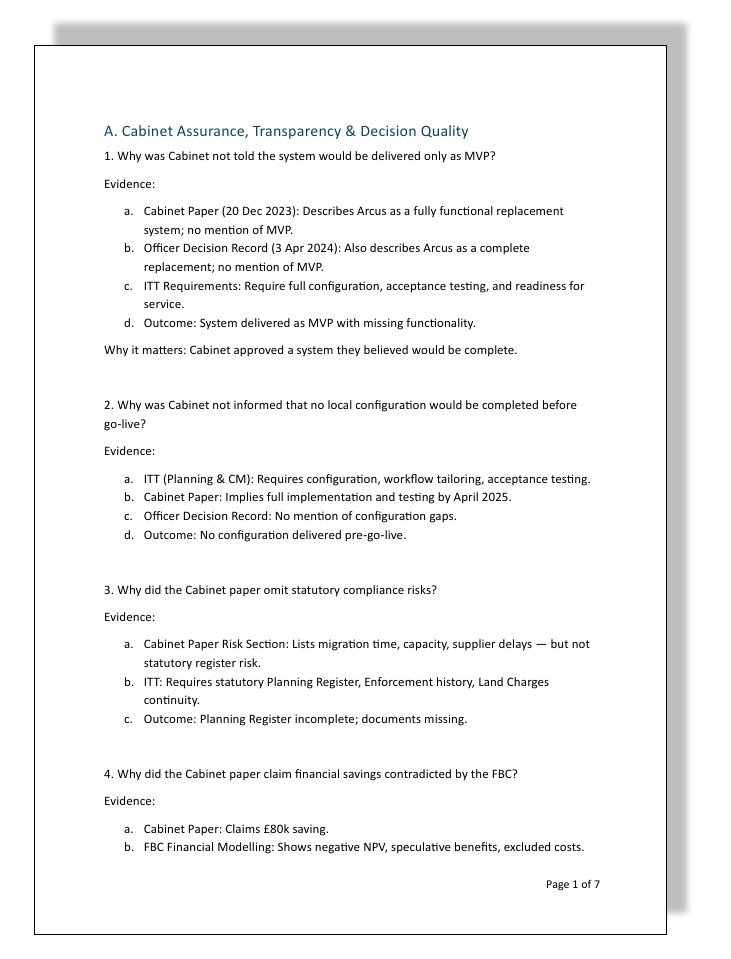
HCS has assembled a set of questions which we trust that a formal audit will consider and resolve. The questions are based on the reference material below, the detailed observations from our own review as reported in the Society’s previous posts, and the transcript of the discussions and debate at the O&S Committee meeting of 18 February.
The questions can be viewed and downloaded by clicking the following image:
Reference sources
The following references link to document referenced for this report. It is important to note that, at the date of publication of this post, the detailed programme management history, including risk logs and issue logs, have been withheld by the Council pending the outcome of the internal audit. Neither HCS nor the O&S Committee Members, have access to that documentation.
January 2023
Future ICT Strategy and Options Paper – January 2023
Future ICT Strategy and Options Presentation – January 2023
November – December 2023
Place Service Software Procurement Full Business Case November 2023_Redacted
FBC Evaluation Final Sheet – CM – Redacted
FBC Evaluation Final Sheet – Plan – Redacted
Soft Market Testing evaluation summary (Redacted) (GCM summary – Place equivalent withheld)
Overview & Scrutiny Committee update – 18 November 2023
Cabinet – 20 December 2023 – Procurement of new IT system for Planning Environmental Health Licensing and Grants
October – December 2025
HCS reports from community use of HBC’s implementation of Arcus Planning Register
February 2026
Overview and Scrutiny Meeting agenda
Members questions in advance of the meeting, with Officers’ written responses
Officers’ report to O&S – February 2026
Officers’ report to O&S – February 2026 – Appendix A: Programme Timeline document
Officers’ report to O&S – February 2026 – Appendix B: Lessons Learnt
Officers’ report to O&S – February 2026 – Appendix C: Arcus and Land Charges Summary
HCS transcript of Agenda item 5, with links to the video record
HCS recording of Agenda item 5
HCS outstanding questions for audit
 Havant Civic Society