
On Monday evening, 25 March, HCS held a ‘Public Forum’ in St Faith’s church with two invited members of Havant Borough Council’s new executive management team, Alex Robinson, Director of Place, and Wayne Layton, Exec Head of Finance and Regeneration. We were all given a warm welcome by the Rector, Tom Kennar to whom Havant Civic Society is grateful for allowing us to use this fine building at the heart of the town for community use. As Tom said, at 800 years old, the church is also by far the longest established community building in the town.
The meeting covered two development projects of significant town-centre interest, the long-running planning application for Portsmouth Water’s ‘New HQ Building’ on Solent Road and Havant Borough Council’s plans to demolish and redevelop the Bulbeck Road car park.
Since both topics are the subject of published planning applications, we thought it would be useful to preface the main meeting with an overview of the ‘planning process’ in order to highlight the points at which members of the public, the local residents, can make their voices heard.
The agenda
The agenda for the evening was divided into four parts. Select an agenda item from this table of contents to go straight to the record of that meeting segment:
- The agenda
- HCS – Overview of the ‘local planning process’ – from the residents’ viewpoint
- HCS – Portsmouth Water ‘New HQ Building’ planning application history
- HBC- Overview of the development proposals for Bulbeck Road car park
- Any Other Business
HCS – Overview of the ‘local planning process’ – from the residents’ viewpoint
The HCS chairman introduced this section with a brief overview of the importance of public engagement with the planning system explaining that the Society’s committee members spend a great deal of time monitoring planning applications and contributing to the development of the Havant Borough Local Plan. Experience has been mixed and it is unfortunate that barriers to public engagement with HBC Planning Services in recent years have resulted in unsound decisions being made, despite the strength and validity of public opposition.
An attempt by the Havant Borough Residents Alliance to engage with the current Local Plan team stalled almost as soon as HCS initiated it in July 2022. It is sad to have to report that since that meeting, some of the formerly-active residents’ associations in the alliance have given up and closed down, leaving important areas of Warblington, Denvilles and Bedhampton unrepresented by active residents’ groups.
The council’s last attempt to take a draft Local Plan to the Public Examination stage was rejected by the Planning Inspector in November 2021, one of the significant reasons given was inadequate public engagement. HCS hopes that under new management, the HBC Planning Services team, properly supported by their peer officers at Hampshire County Council Highways, will engage more closely with the residents. By ensuring that the residents’ voice is listened to and concerns debated as an integral part of the validation of planning proposals, HBC would make more efficient use of over-stretched resources, ‘working smarter’ to avoid unnecessary effort later on in the planning lifecycle.
This set of slides show three broad stages in the lifecycle of a development project; Pre-Planning, a step normally closed to public view, Planning Consultation at which the public gets a limited time to make written comments and time-limited deputations at Planning Committee meetings, and Construction and Occupation, during which Planning Services monitor and enforce compliance with the terms of the approval, including any documented conditions.
Changes to architectural design and understanding of the intended use of proposed premises can all evolve throughout the period between initial publication of a planning application and the point at which a decision is finally made. The public will only appreciate such changes though constant monitoring of new documents added by the HBC Case Officer to the project file and made visible through the Public Access portal following publication.
While the applicant has ongoing contact with the Planning Services team throughout the process, active engagement with the general public is tightly controlled and strictly limited. Public comments are limited to textual comments raised online (or by letter which should be scanned and loaded). Should an application come before a Planning Committee, for example by being ‘red-carded’ by a ward councillor, any permitted public deputation is strictly limited, in our experience usually to about three minutes.
Once a planning application has been approved and its ‘planning conditions’ documented, the Applicant has the option to raise a ‘Section 73’ Planning Application to have any of those conditions removed or modified. This process is illustrated in the slides with an example taken from the recent developments at numbers 5 – 11 East Street.
Click the image below to view the slides:
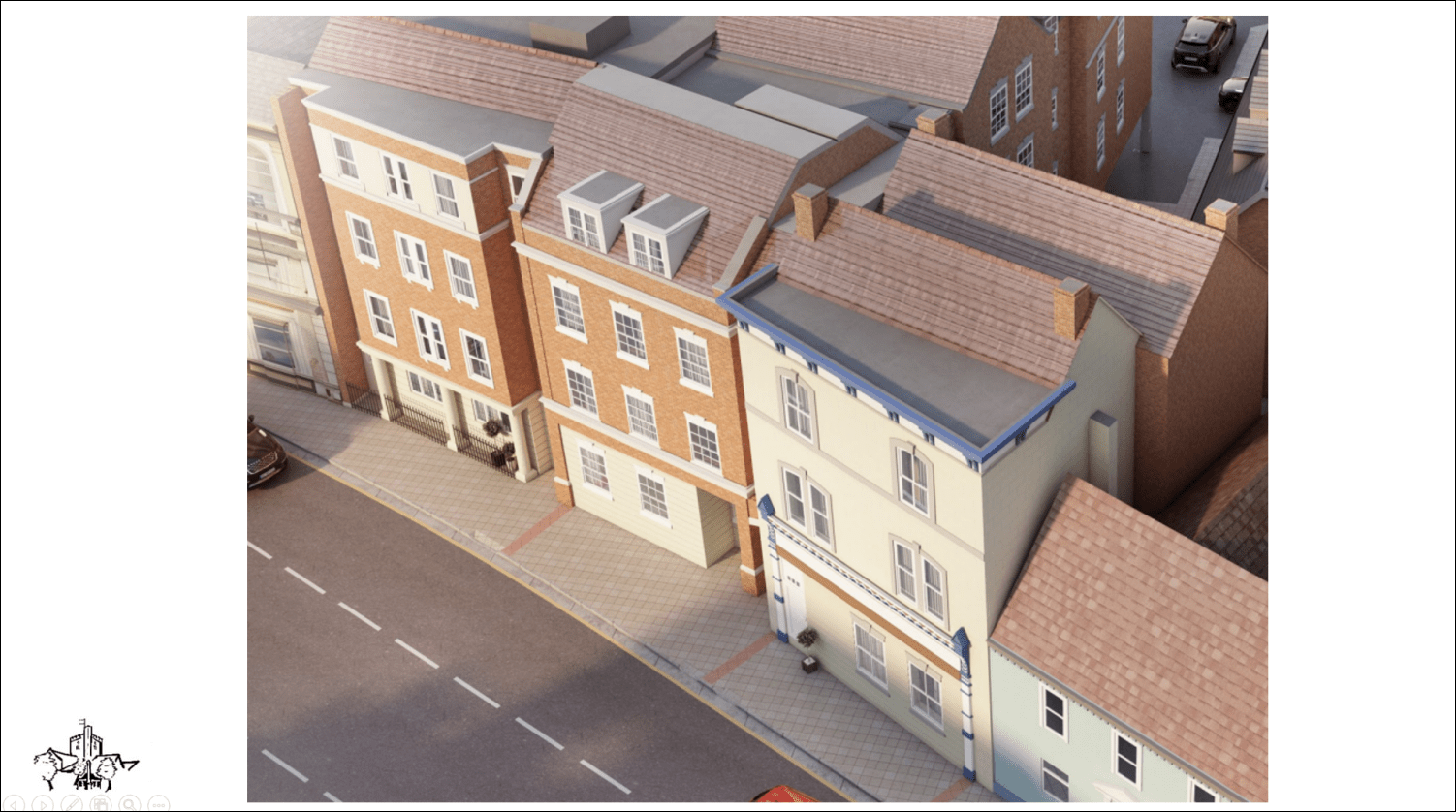
It was encouraging to hear Alex Robinson describe the slides as ‘a noble attempt’ at summarising the process flow and we would welcome the opportunity to improve it through a round-table review with his Case Officers.
As the first slide states, public engagement with ‘the Planning System’ provides you with the opportunity to have your say in how the town is developed. Your opportunities to engage with the Planning System are limited, so grab them while you can. If you don’t comment, you can’t complain!
In the interests of time, questions were not taken from the floor, although one gentleman did ask how he was supposed to find out about the existence of planning applications. (See the main menu of the HCS website – ‘HBC Links‘ for a simple way into the HBC website pages.)
HCS – Portsmouth Water ‘New HQ Building’ planning application history
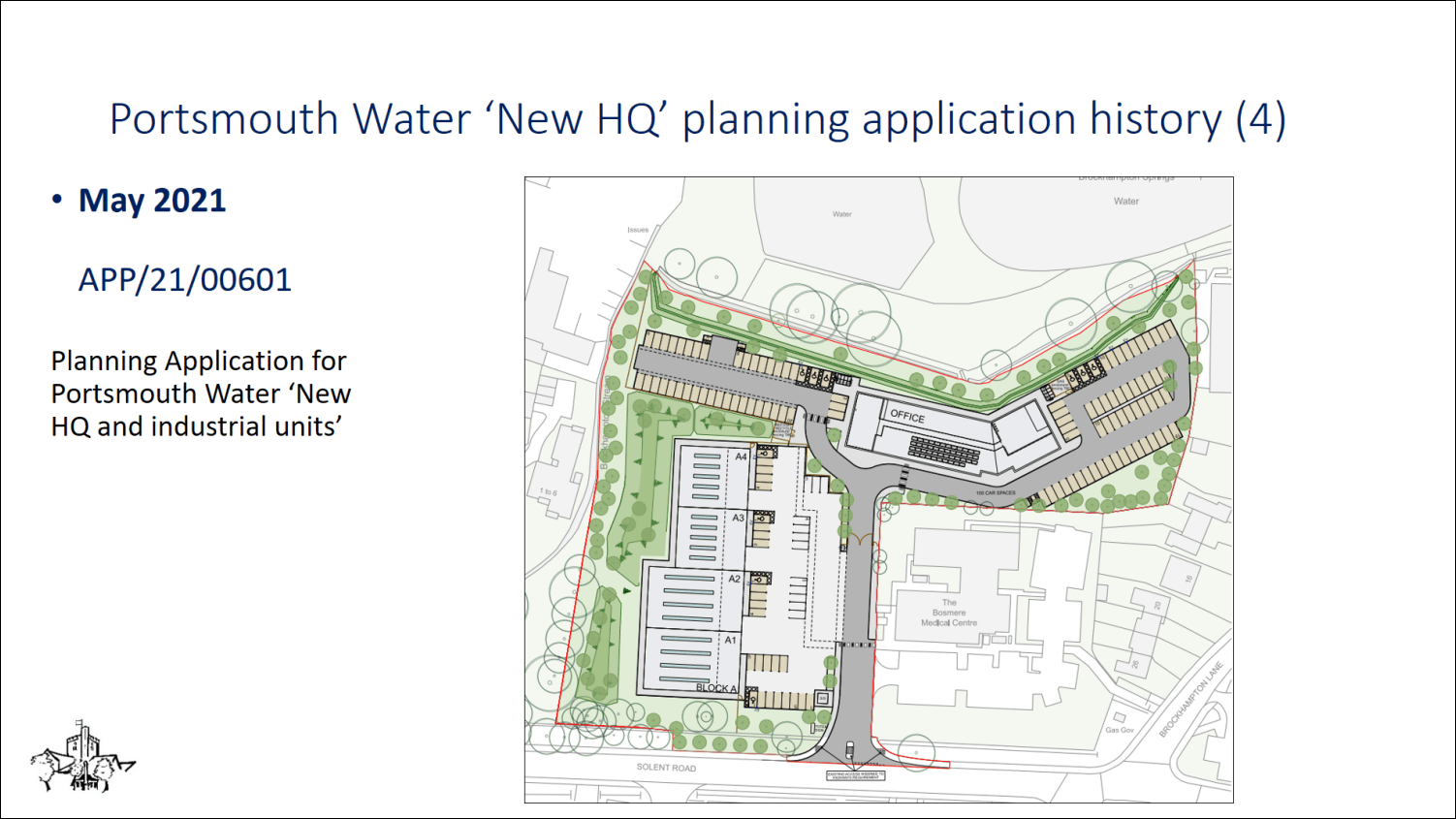
This planning application provides an example for which a Development Consultation Forum (DCF) had been run at the pre-planning stage. HCS had been invited to attend the DCF and used the opportunity to present the concerns of the Bosmere Medical Centre, Havant’s largest NHS GP practice, which had not been notified of the event, despite the clear and obvious impact of the proposal. Four years later, those concerns have still not been addressed.
The fundamental public concern is the failure of both Havant Borough Council and Hampshire County Council Highways to engage with the Bosmere Medical Centre, the current sole users of the road now proposed to be shared.
As before, click on the image to view the slides:
The following questions and concerns about this application had been raised in advance of the meeting:
1 The main subject of concern is the impact of the proposals on the ability to access the Bosmere Medical Centre, safely and in good time for appointments. With 19,000 patients on the books, this has generated a significant number of the concerns raised to Planning Services.
2 Why have the serious concerns over shared access through the currently dedicated medical centre access from Solent Road been ignored?
3 Why have significant comments made early in the development process, at the DCF and through earlier consultations on the planning application, been consistently ignored?
4 Solent Road traffic is already near or at capacity during peak times. It is difficult to see how the additional load on Solent Road of the expected HGV, LGV and car movements to both the office site and the proposed industrial / warehouse units can be accommodated.
5 Lack of public visibility of Portsmouth Water’s masterplan for its landholdings feeds residents’ distrust.
In his response, Alex Robinson referred to ‘a number of points for clarification’ which had been raised by ‘the County’ in a recent document available for view on the Public Access document library. To the best of the Society’s knowledge at the time of the meeting, no such document had been seen, raising concerns that important documents might sometimes be filed with ‘restricted access’ and therefore not visible to the general public.
The mystery was only cleared up two days after the meeting, when this document from HCC Highways became visible, dated 26 March. It appears that Alex may have been referring to an earlier internal draft of this document. (HCS will be raising a formal response in due course to the HCC Transport Planner and the HBC Case Officer regarding the content of this document.)
When pressed on the point of the lack of visibility of Portsmouth Water’s masterplan for its current and former Havant landholdings, Alex told the meeting that he would like to see masterplans from major developers; housing and commercial, for their related development proposals in the Borough.
At the end of this segment of the meeting, it was agreed that HBC would take away the questions raised for response. We will publish the feedback when we have it.
HBC- Overview of the development proposals for Bulbeck Road car park
The proposal to demolish and redevelop the Bulbeck Road car park site has been likely since HBC announced its purchase of the site in December 2019. Following the failure of two bids for Levelling Up funding, a grant for the demolition part of the work was received from the UK Government’s Brownfield Land Release Fund in late 2022. The funding award is contingent on the timely approval of an outline redevelopment plan and the successful sale of the prepared site to a suitable developer.
Wayne Layton took the meeting through a slide presentation covering the case for change, the demolition plan and observations on the constraints within which the future redevelopment project must work.
Click on the image to view:

We had asked for questions ahead of the meeting and were not surprised to find that the comments and questions submitted echoed those which are visible on the first planning application for the demolition works:
1 The bulk of concerns received relate to parking, including existing issues with out-of-town / commuter parking on town-centre residential streets. Concerns were raised over the additional load from displacement parking when the car park is demolished.
2 Traffic access issues (to/from Park Road South) for residents, care workers, staff and visitors to Watermill Court, Springwell and Homewell.
3 Demolition and construction issues relating to the anticipated dust and noise from demolition and construction activity.
4 What guarantees do we have that we will not suffer undue vibration and noise levels, given the false assurances HBC gave to Denvilles’ residents for the building of the new Amazon depot?
5 Residents are concerned about ‘wellness’ and ‘quality of life’ issues if loss of daylight results from the building of a proposed 6-storey structure, for existing residents that include aged and vulnerable people within the community.
6 What will be the impact of the development work on existing known problems with sewage blockages in the vicinity?
7 How will the access via Bulbeck Road be kept clear for emergency vehicles, given all of the illegal parking that currently takes place each day?
On comments relating to disturbance from the demolition and re-development work at the site, Wayne Layton’s response was that the detail was contained within the Method Statement a summary of which had been included within his presentation. The audience reaction was understandably sceptical, having seen the method statements of ‘Considerate Contractors’ before.
The bulk of the comments from the floor reflected the concerns already made on the planning application – in a single word, ‘parking’. One member of the audience had already lost two potential buyers for her property due to the threatened removal of the only accessible car parking, and her concerns were clearly echoed by the other residents of the surrounding area. Residential streets near the town centre such as Grove Road, Orchard Road and Bellair Road have been complaining for years about the impact of street parking, particularly by commuters avoiding long-stay parking charges.
This situation will only be made worse by the displacement of town centre residents’ vehicles on the closure and demolition of the Bulbeck Road facility. The obvious solution would be the introduction of a residents’ parking scheme which would likely be supported by many town centre homeowners. Unfortunately, the responsibility for on-street parking moved from HBC to HCC exactly a year ago on 1 April 2023, so such an initiative would require a joint project by both tiers of the local authority.
Residents raised unsettling examples of the anti-social behaviour (ASB) statistics noted in the HBC presentation, along with observations that the ASB problem had become noticeably worse following publication of the council’s intent to demolish the car park.
The timelines for the council’s Bulbeck Road project are challenging and if we are to end up with something more concrete than just another surface car park like the North Street former site of ‘The Star’, it will require close engagement between the town and the council. It will also test the council’s new-found resolve for master-planning with its need to interlock with the introduction of an effective residents’ parking scheme. Residents will also be looking to the planning enforcement team to pay close attention to monitoring the effectiveness of the controls promised in the Method Statement.
Any Other Business
Unfortunately, with such a full agenda, two of the three AOB subjects requested by residents in advance of the meeting will have to be rescheduled to a future event. The first subject, the wider issue of town-centre residents’ parking had already received some attention during the Bulbeck Road discussion.
The second subject reflected concerns raised against Planning Application APP/23/00996 at McCormack House in East Street, next door to The Spring, particularly the lack of a clear Travel Plan and the perceived risk of excess parking/waiting in the area, notably in Orchard Road and Lower Grove Road.
The third subject will eventually drive a dedicated future meeting, being the growing problem of traffic generated by the Amazon site, rat-running through town centre residential streets. The issue was first predicted by HCS long before the planning application was documented as ‘received’ and ‘validated’, with both key events logged on the same day – 23 February 2021. Now that the site has been in operation for more than a year, the traffic issue is compounded by the continuing failure of both local authority tiers to either enforce the planning conditions set, or to implement the simple traffic monitoring measures required to measure the scale and growth of the problem.
 Havant Civic Society