
The planning application at the former Dunham Bush manufacturing site is shortly up for approval by the HBC Planning Committee. The development will further strain the profile of traffic generated by the Havant North industrial estate without providing the quality and security of employment that the residents of the borough need.
It is worth taking a few lines to consider the background to this.
Background
When the Havant North industrial estate was first laid out, traffic wasn’t really much of a problem. At its peak in the late sixties and early seventies, the estate hosted many of Havant’s world class manufacturing plants, companies such as Kenwood, Goodmans, Wyeth, Colt and Dunham Bush. Most commuters arrived on foot from the purpose-built West Leigh housing estate, by bike from further afield, or inbound by public transport to the nearby town centre bus and train stations. In those days, the relatively small car parking areas in front of the factories were reserved for management, sales reps and visiting suppliers.
The profile of motorised traffic generation from the estate was relatively low, and the size and weight of the commercial vehicles operating from the estate was much smaller. In 1962, when Kenwood relocated its manufacturing facility to the Havant North industrial estate, the maximum allowable weight for articulated vehicles was 24 tons, with a length limit of 33 feet across three axles.

Sixty years later, much has changed
Six-axle articulated vehicles measuring 54 feet in length and weighing up to 44 tons have now become commonplace on UK roads and with Amazon now operating at 32 New Lane, the estate hosts a 24/7 business operation for the first time in its history.
That one company alone now generates two and a half thousand traffic movements into and out of the Havant North estate each day.
Two years after operations began and without any effective enforcement of the planning conditions placed on the site, Amazon will be free to push the limits of its traffic generation until the natural constraints of the local residential streets start to throttle its business.
The residents of Crossland Drive, the main access road into the estate, already know this to their cost.

It’s about to get worse
The planning application for 8 Downley Road, the old Dunham Bush factory site, is coming before the HBC Planning Committee next week, with a recommendation by the Planning Officers that the Committee approve the development.
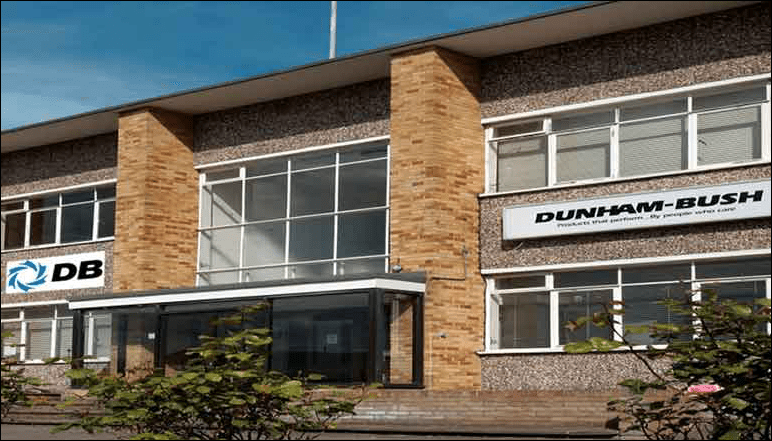
The proposal will clear the site and develop three new units with a total of eight HGV loading bays. The old manufacturing site was approved for class B2: General Industrial Use, while the new units are clearly designed for use as class B8: Storage and Distribution. The difference between B2 and B8 is relevant to the profile of traffic generation.
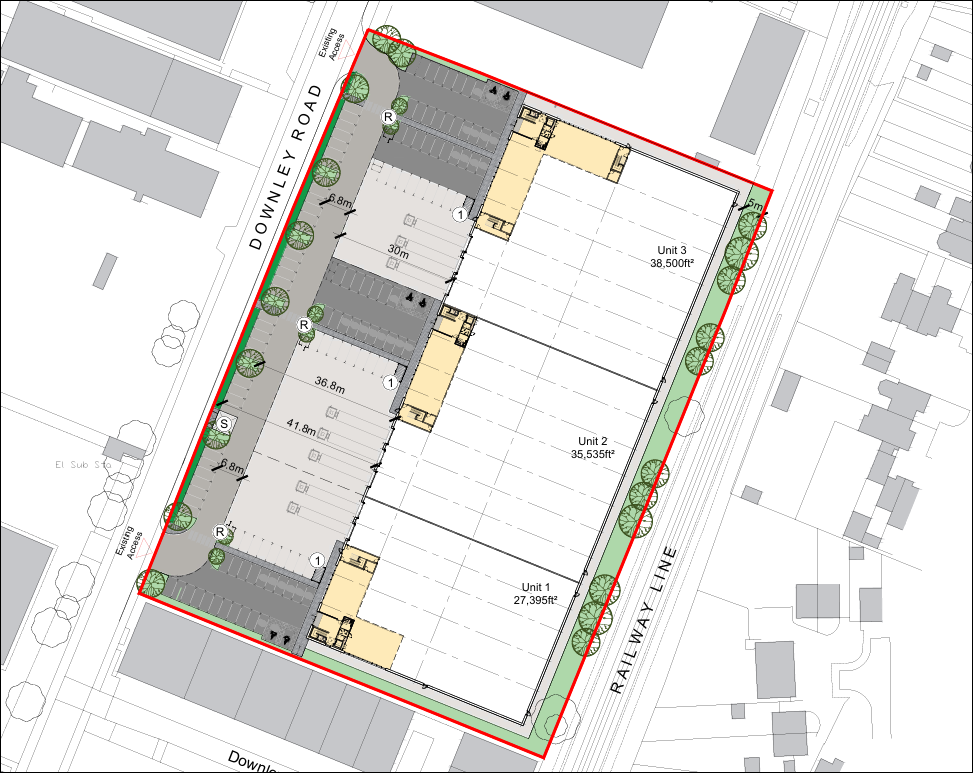
Approval of this development will lead to the generation of more than seven hundred HGV, LGV and car movements daily, most of which will – you guessed it – be accessing the location via Crossland Drive.
That may be small beer in comparison with Amazon’s daily numbers, but it all adds up to more misery for the poor folk of Crossland Drive. Ironically, it’s not going to make the Amazon site manager’s job any easier either as the estate roads become more saturated by traffic. The DPO1 site operation needs to get ‘waves’ of empty vans in, loaded and sent back out in the shortest possible time, often leaving the van drivers to resort to re-arranging their loads on the surrounding streets. Turnaround time on-site is critical since the internal space needs to be vacated before the next wave is called in.
The art of the Transport Consultant
Planning applications like this one must have Transport Assessments included in the bundle of associated documents. The sole purpose of these documents appears to be to prove, in as many unintelligible pages and appendices as possible, that the traffic movements generated are no more than those generated by the previous occupier.
For the 8 Downley Road site, in the absence of any data pertaining to previous use, the transport consultant resorts to the usual TRICS algorithms to generate ‘proof’ that the 707 predicted daily traffic movements are considerably fewer than the 745 that they calculated would have been generated under the Dunham Bush occupation. (Click here to see the summary, as reflected in the HCC Planning Officers assessment.)
This same trick was played, by the same Planning Agent and the same Transport Consultancy, to justify the Amazon DPO1 development at 32 New Lane.
The Havant Borough Council planning officer declares a submitted application ‘valid’ by ticking a box to say that a Transport Assessment ‘exists’. However, we have seen little evidence that these officers, who should be familiar with the context of the site, ever read the detail content of these documents. That level of analysis is delegated to the Winchester-based planning officers at the County Highways department and evidence to date shows that their level of appreciation of the context of the local Havant street network is low.
Despite the Transport Consultant’s sales pitch, the Downley Road site, like the old Wyeth site before it, will now be generating HGV movements of a much larger size and at a much greater frequency than at any time in its sixty year history. Virtually all of that traffic will be heading in and out through Crossland Drive on its way through Havant town centre to the A27 and the A3M.

To fully appreciate the Transport Consultant’s art, it’s worth looking at the ‘Swept Path Analysis’ in the transport documentation. Take a good look at the following extract from the Transport Assessment. What it shows is the on-site car parking for staff and visitors, through which HGVs like those in the previous diagram will access and manoeuvre into the three loading bays on the north side of the site. The ‘Swept Path’ diagrams on the right show that it’s technically feasible.

There are similar drawings for the five other loading bays on the south side of the site. The fact that the three units could be rented to three different companies with potentially conflicting HGV movement times is ignored.
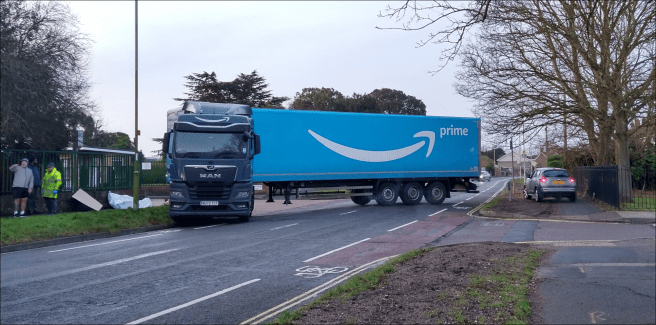
This planning application will almost certainly be approved, unless somebody bothers to query the TRICS calculations used to provide the ‘previous traffic generation’ data. Or unless somebody perhaps raises the concern that not all line haul HGV drivers are fully skilled at manoeuvring:
Like Amazon before it, the paperwork ticks all the necessary boxes and local authority planning officers are not paid to think outside those boxes. The council’s Economic Development Manager has already given it the thumbs up.
The applicant’s Planning Agent and Transport Consultant ‘have form’, having previously pulled the wool over the local authorities’ eyes with the Amazon DPO1 development. The Planning Agent’s statement that “‘the proposals could create between 54 – 149 number of jobs in association with all three commercial units, all within the Borough.”, needs to be taken quite literally, the same agent was responsible for the suggestion that the anonymous Amazon proposal could bring a thousand jobs to Havant.
Observation of commuting patterns at Amazon’s DPO1 site over two years of operation suggests that a significant proportion of the warehouse shift workers are actually low-cost legal immigrant labour commuting in from accommodation outside the borough. The van drivers, once again promised as local employment opportunities, are all third party contractors commuting in every morning in empty vans, contrary to the business operation signed off in the Amazon planning conditions.
It seems likely that history will repeat itself at 8 Downley Road unless the Planning Committee think outside the boxes that the planning officers have ticked. Maybe once Havant gets merged into a new ‘Greater Portsmouth’ unitary authority, we might start to see some joined up analysis of planning applications.
The Havant North employment area is quite clearly the wrong place to put high volume logistics operations which need direct access to the strategic road network, particularly when there is no clear directional signage and no effective monitoring of the load on the town’s residential streets.
Without singling out any particular operator, the simple installation of ANPR cameras at the estate entrances would provide the local authority with a valuable insurance policy against uncontrolled HGV and LGV traffic growth. Three locations would be enough, one at the Crossland Drive / Petersfield Road junction, one at the Bartons Road / New Lane junction and the third at the New Lane / Eastern Road junction.
 Havant Civic Society
It’s not too late to object. All comments received from the public before a decision is made must be considered, even those received after the official closing date for comments.
LikeLiked by 1 person